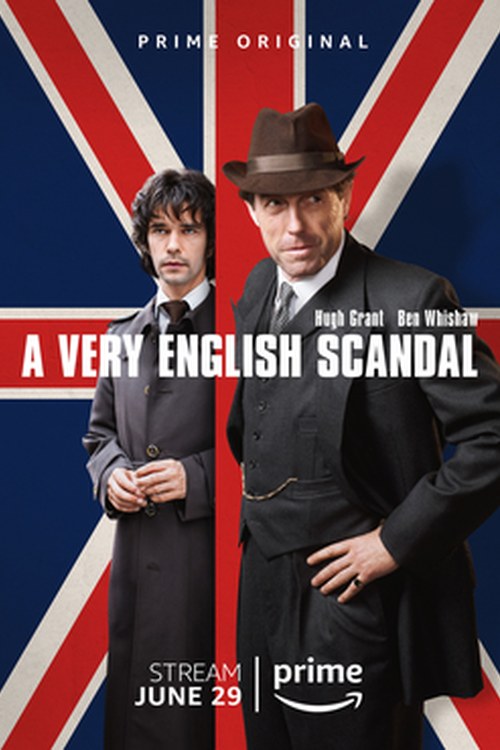
A Very English Scandal · Season 1 · Episode 1 · 20 May 2018
S1E1 Episode 1
A clipped, vicious premiere where jokes become evidence, paperwork becomes threat, and Jeremy Thorpe mistakes murder for management.
THE MOMENT Thorpe's first encounter with Scott, played against the social comedy of postwar England, makes the danger of the relationship visible before either man does.
The opening episode establishes Thorpe's power and the furtive, doomed shape of the affair with Norman Scott. Davies plays it partly as establishment comedy - the rituals of the Liberal Party, the closed world of the Commons - and partly as a portrait of a man who has learned to perform innocence so well he has almost stopped noticing the...
Full episode analysis below. Spoiler-light verdict above.
Updated
The joke lands first. Jeremy Thorpe repeats Harold's remark about the whippet, and the episode lets that brittle drawing-room rhythm set the trap. This is a world where language arrives polished, insult has tailoring, and danger enters as a sentence read aloud. Then a letter appears, and the laughter has a job to do. By the end, the man who wants discretion and order has moved from containment to a sentence that cannot be mistaken for strategy. The premiere is built as a slide, and its craft lies in making the slide look like manners. ## The Joke Is the First Weapon
The opening beat teaches the episode's method: scandal travels through speech before it becomes action. Jeremy repeating the whippet line is comic in shape, but the comedy is already a social instrument. Someone says something. Someone repeats it. The remark gathers force because it can be quoted. In this world, a line can wound, bind, expose, or threaten. That makes the blackmail letter's arrival feel less like an interruption than a promotion. The episode has already shown talk as currency. Now it shows talk with consequences. The letter declares, "Jeremy and I have had a homosexual relationship..." and the ellipsis does heavy work. The sentence does not need to finish in order to detonate. The danger is the record, the paper, the possibility that private life can be converted into public evidence. The writing's sharpest move is tonal control. It does not abandon wit when fear arrives. It lets wit become fear's polite suit. That early rhythm is the episode's operating system. Everyone is trying to manage language: who says what, who has proof, who can be persuaded to stop saying it. The premiere understands that scandal begins before the act is exposed. It begins when the act becomes tellable. ## Discretion Has a Staff
Pedro enters as more than a private companion or convenient confidant. The dossier places him inside the machinery of discretion: he keeps things ordered, helps handle crises, and urges protection within Jeremy's private orbit. His early self-description, calling himself 80% and then qualifying what that means, fits the episode's interest in partial declarations. People define themselves carefully here, leaving room for deniability, desire, and retreat. That carefulness extends to Elizabeth, whose place in the hour is tied to support and employment stability. She sits near the domestic and administrative systems that allow Jeremy's life to continue while trouble gathers at the edges. The show is smart about that. Scandal is never just a secret between two people. It has secretaries, visitors, beds for the night, lost objects, letters, and arrangements. It needs a household before it needs a courtroom. The arrival of Peter Freeman with a bed for the night is one of those small practical beats that gives the hour texture. A bed is mundane. In this episode, mundanity is never innocent. The object says hospitality, cover, temporary solution. It also says private life requires logistics, and logistics create witnesses. The more Jeremy tries to keep his world intact, the more people and objects are needed to hold that shape. Control is not clean. It is cluttered. It needs helpers. It leaves traces. ## Norman Turns Need Into Leverage
Norman Josiffe is introduced through accusation, but the episode refuses to leave him as a single function. He calls himself a victim and says he was in thrall to Jeremy. Later, his practical demand becomes central: he wants his National Insurance card and access to benefits. That detail drags the conflict away from pure sexual scandal and into bureaucracy. A missing card becomes a pressure point. Paperwork becomes a fuse. This is where the hour earns its nastiness. Jeremy wants Norman to stop contacting him and prevent the scandal from spreading. Norman wants a document that affects his ability to live. Those desires cannot share the same room peacefully. Jeremy and his allies can treat Norman as a problem to be managed, but Norman keeps attaching the problem to a specific, ordinary demand. Give him what he says he needs. Make the system work for him. Answer him personally. The Dublin extradition threat is the hour's bluntest use of institutional muscle. Norman is shown an order and told that if he does not stop, he will be taken back to the United Kingdom to face trial. It is a legal threat presented as a solution to embarrassment. The scene does not need to overplay villainy. The coldness is in the conversion: a government-shaped tool is aimed at a personal mess. The weakness in this stretch is density. Norman's emotional temperature can spike faster than the scene can absorb. The beats are clear, the motivation legible, but legal pressure and personal grievance sometimes arrive as stacked information rather than pressure allowed to breathe. Still, the core works because the card is concrete. The scandal has a document, and the demand has one too. ## The Suitcase Is a Warning Label
Diana finding the lost suitcase at Victoria Left Luggage looks small until the episode's architecture comes into focus. This hour keeps returning to containers: letters, cases, documents, cards, luggage. The scandal does not float. It is carried. It is misplaced. It waits behind counters. It can be collected tomorrow morning. The suitcase beat widens the threat map. Jeremy's problem is Norman's voice and the material trail around that voice. The open loops make that clear: letters and documents may resurface, including references to bunnies and House of Commons notepaper. The episode plants the fear that evidence has a life independent of intention. People can be silenced, warned, threatened, or delayed. Paper is harder to discipline. As craft, this works because the hour keeps its suspense procedural without turning dry. The mechanics are specific enough to create anxiety: Victoria Left Luggage, an item found, a collection set for the morning. The limitation is that Diana's beat, in this episode alone, plays more like connective tissue than a scene with its own charge. It matters because the plot says it matters. It has not yet developed the same human bite as Norman at the door or the Dublin threat. Even so, the image sticks. A suitcase in left luggage is scandal in miniature: packed, tagged, temporarily out of sight, waiting for the wrong person to ask the right question. ## The Last Line Burns the Room Down
The final turn works because it is not random. Jeremy's central contradiction has been visible all hour. He wants to control Norman without destroying his political and marital life. He wants stopping rules. He wants pressure to look like order. Every attempt at containment proves how little he controls once Norman refuses to disappear. So when Jeremy concludes, "Norman Scott has got to die," the line lands as escalation rather than twist. The episode has moved from gossip to letter, from letter to legal threat, from legal threat to unresolved demand. The final sentence is obscene because it is phrased like a practical conclusion. That is the horror. Murder enters the conversation wearing the same tidy grammar as the earlier arrangements. The pacing helps. After so much talk, silence becomes a pressure chamber. It gives the lethal thought room to form. The episode has trained the viewer to listen for language, then makes the most consequential line feel like the point at which language stops being enough. As a premiere, this is clean, nasty construction. It does not sprint toward violence. It makes violence feel like the final, poisoned version of administration. ## The Verdict
"A Very English Scandal" opens with a tightly controlled first hour: funny at the edges, sour at the centre, and disciplined about how private panic becomes public danger. Its best idea is simple and sharp. Scandal is paperwork plus speech, and Jeremy Thorpe is dangerous because he understands both until he decides they are no longer sufficient. The episode's weakness is compression. Some connective beats, especially around the suitcase, feel more functional than charged in isolation. But the spine holds. The premiere plants the season's core question with force: if legality, charm, and pressure fail, how far will Jeremy go to survive Norman Scott? Written by BollyAI, reviewed by our editorial team.