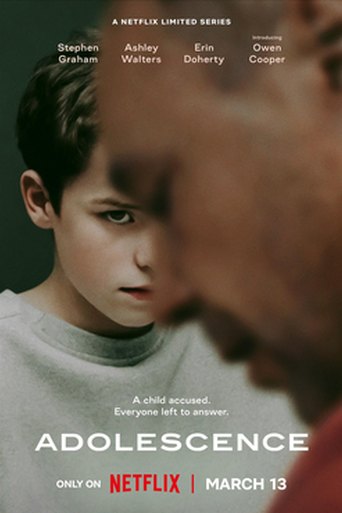
Adolescence · Season 1 · Episode 2 · 13 March 2025
S1E2 Episode 2
A patient, school-wide procedural that trades episode one's claustrophobia for scale, and lands its hardest evidence on a boy who runs.
THE MOMENT A boy who spends the whole hour trying to leave the conversation instead of finishing it, and what finally makes that running stop.
The case moves out of custody and into the building where Jamie was a student. **Detective Bascombe** and Detective Frank work the corridors and classrooms, chasing one small, specific object still missing: the knife. A phone call outside the gates opens the hour before a single officer sets foot inside. Between a shakedown over pocket money, a boundary drawn around...
Full episode analysis below. Spoiler-light verdict above.
Updated
A phone rings before a single officer reaches the gate. "Um, I'm outside your school," the voice says, and the sentence is enough to turn a Tuesday into evidence. The first hour of this case needed one house, one warrant, one boy. The second needs an entire building: hallways, a staff room, a card with a station number and a crime reference printed on the front in case anyone needs to call later. Somewhere inside, Adam still owes Fredo £1.20, an old debt a murder inquiry has not cancelled. The school keeps running its own small economy underneath the much larger one now sitting on top of it.
Ordinary Cruelty Keeps Running Underneath
The widening is the point. Episode one built its pressure from a single address and everyone who had to answer for what happened inside it. This hour spreads the same procedure across a school: Detective Bascombe and Detective Frank move corridor to corridor, handing out a card with a station number and a crime reference, the same bureaucratic reflex that turned the Millers' home into a case file now turned on an entire institution. The detail that keeps the episode honest is how little the building cares. Adam still owes Fredo £1.20, mid-investigation, because a murder inquiry does not suspend a schoolyard debt. Kids still owe each other money. Bells still ring on schedule. A case file is being built one classroom at a time, and none of it interrupts the smaller, older economy of who owes what to whom. That contrast does the hour's early work without spelling it out: institutions process tragedy in the same paperwork register they process everything else, and the paperwork does not care what it is attached to. It is the same insight episode one built its dread from, just distributed now across dozens of small transactions instead of one family's front door.
The Investigation Draws Its Own Boundary
The case has a conflict of interest sitting inside it, and the hour spends one sharp beat acknowledging it before moving past. Students start working out that Detective Bascombe is Adam's father, the kind of detail that could turn an interview room into gossip. Detective Frank cuts the conversation off before it spreads, protecting the process rather than debating the connection. It is a small procedural correction, not a confrontation, and the show is exact about the difference: nobody is accused of bias, nobody needs to be. The beat exists to establish a rule and enforce it in real time, personal entanglement inside a case gets named and closed, not left to spread through a classroom. That discipline matters more than it first appears. An investigation this dependent on children telling the truth about a friend's death cannot survive turning into a story about whose father works where. Frank's interruption is the hour's quietest piece of craft: a boundary drawn and held before it can become a subplot the episode does not have time for. The show trusts that discipline to register without ever being announced as admirable.
The Reluctant Witness Gives an Inch
Not everyone in this building wants to be interviewed, and the episode is patient about the ones who resist. Jade starts by pushing back against being questioned at all, described in the hour as upset, before eventually agreeing to talk. There is no scene of triumphant breakthrough here, no speech that turns the moment around. The shift simply happens, over time and under pressure, from refusal to cooperation, the same way a reluctant witness moves in any real investigation: worn down by persistence rather than convinced by argument. The episode uses this arc as a rehearsal for its bigger one. Information in this hour does not arrive because someone wants to give it. It arrives because someone eventually cannot keep holding onto it. Jade's small concession sets the pattern the episode will use again, at far higher stakes, before the hour is over. Watch how little the show asks of the performance to sell that shift: reluctance, then response, no bridge explained. The gap is the point. Nobody in this building volunteers what they know. The same shape of surrender repeats later in the hour, for a much bigger admission.
A Vocabulary Lesson Becomes a Motive
The hour's most consequential scene is the quietest one. Adam wants to help away from the group, and what Adam offers is not a new witness or a new alibi but a translation of what showed up on Instagram, read correctly for the first time by an adult in the room. Somewhere in that same stretch, a direct question lands, asking plainly what a word like incel is even supposed to mean to the kids using it. The show does not turn this into a lecture. It treats the internet's private vocabulary as evidence with the same weight as a fingerprint, because in this case, it might be. The premiere established what happened to Katie. This hour starts establishing why, and the why is not a secret relationship or a stalking plot the detectives assumed going in. It is language, the kind that travels between teenagers faster than any adult in the building can track it, until one of them is asked to define it out loud. BollyAI's read: this is Adolescence's sharpest structural idea, that the actual motive was never hidden, just spoken in a dialect the investigation had to learn to translate.
Running Becomes Its Own Confession
Everything the hour has been building lands on one boy who spends most of it trying to leave the conversation. Ryan is confronted directly and accused of having a hand in a friend's death, and the instinct is to run rather than answer. The chase is not the point. What happens after it is. Cornered, Ryan stops refusing and gives up the detail the entire episode has been organized around: the knife the case had been missing since the first interviews was Ryan's own. Detective Bascombe, who has spent the hour pressing every room in the building for exactly this object, gets the answer from the one witness who tried hardest not to give it. The arrest that follows, on suspicion of conspiracy to murder, reframes everything that came before it: the card with the reference number, Frank's boundary, Jade's slow cooperation, Adam's translation. None of it was separate. It was all the same net closing at different speeds. Film Stories's own verdict on the hour: "The second episode isn't quite as viscerally effective as the first, but it gives more food for thought." BollyAI's read agrees with the trade, not the complaint: episode two spends its intensity budget on information instead of adrenaline, and the season needed the information more. The knife finally has an owner. What it means, and what Jamie's actual role in all of it was, stays open.
The Verdict
Episode two trades the premiere's single-room intensity for institutional sprawl, and that is a fair exchange, not a step down. The hour earns real information ownership: it needs a schoolyard debt, a drawn boundary, a reluctant witness, and a translated screenshot before it can hand the case its missing knife. Nothing about that structure feels padded. Every stop along the way earns its place in the net that eventually closes. Where the hour comes up short of the premiere is texture rather than construction: the corridors carry information efficiently, but they do not yet carry the same dread the Miller kitchen managed in the premiere. In the season's arc, this is the hour that answers the case's most mechanical question, where the knife went, while opening its most human one, what incel actually meant to the people using it. BollyAI's read: a very good hour that trades feeling for evidence, on purpose, and wins that trade.
"The second episode isn't quite as viscerally effective as the first, but it gives more food for thought."
Film Stories