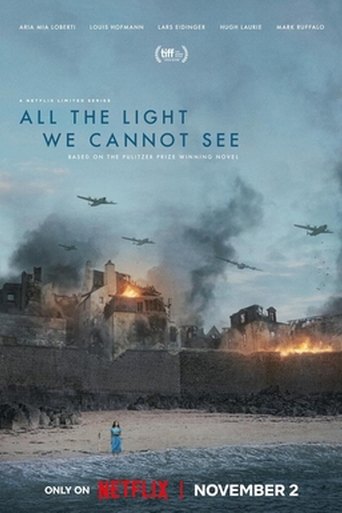
All the Light We Cannot See · Season 1 · Episode 1 · 2 November 2023
S1E1 Episode 1
A tense first signal where radio becomes rescue, evidence, and threat, though the mystery sometimes outruns the feeling.
THE MOMENT Marie-Laure navigating the model of her neighbourhood by touch alone - the series' strongest single image, and the one that earns the novel's central metaphor.
The premiere establishes both timelines - young Marie-Laure learning Paris through her father's wooden models, Werner discovering a physics radio programme in an orphanage - with visual clarity if not thematic depth. Aria Mia Loberti's naturalistic performance is immediately the series' most persuasive element.
Full episode analysis below. Spoiler-light verdict above.
Updated
The bombs are falling. A caller asks Papa, or Uncle Etienne, to come home, and the episode answers with a radio voice reading Jules Verne into the dark. That is the hour’s cleanest idea: danger arrives as sound before spectacle. A broadcast continues. A frequency matters. A girl in Saint-Malo becomes a target before she becomes a rescue mission. "Episode 1" works best when it treats radio as intimacy with teeth, a private lifeline that becomes evidence the moment the wrong person hears it.
The Bombs Speak Before the People Do
The opening puts crisis before explanation, the right instinct for this material. the caller says the bombs are falling. the broadcast continues with Twenty Thousand Leagues Under the Sea. The contrast does the work: destruction outside, literature on the air, a human voice refusing to let the night become only military noise.
That choice gives the hour an early thesis. Communication is survival, and communication is exposure. Every voice in the episode pays a price for being traceable. The broadcast is not decoration. It is the engine.
The hour’s strongest line makes that bargain plain: "I know that broadcasting could get me killed, but I will not be silenced." The line risks bluntness, but bluntness has use here. The episode is built around people who keep speaking when silence would be safer. The bombs create one kind of pressure. The radio creates another. One falls from the sky, the other moves through walls.
The limitation appears just as early. The premiere leans on mystery through withheld context: who is speaking, who is listening, and how these transmissions connect. That withholding keeps the plot moving, but it makes emotion arrive a beat late. The hour has atmosphere immediately. It has clarity in fragments.
A Frequency Becomes a Trap
The phrase "Shortwave 13.10" lands like a password and a warning. It identifies the frequency tied to the professor broadcast, and the episode treats it as more than a technical detail. It is a meeting place for memory, curiosity, and surveillance. Once Werner Pfennig builds and uses his contraption, the frequency stops being abstract. It becomes a device that can find someone.
That is where the premiere sharpens. Werner wants to locate the girl and keep receiving or using shortwave 13.10. Later, he is ordered to track her down. The contradiction is clean: duty pushes him toward the target, but the frequency gives that target a personal charge. He is not just following a line on a map. He is following a voice that has already pulled him in.
The hour handles this tension well because it lets the mechanics speak. A contraption is turned on. A broadcast becomes active. A search becomes possible. By, the line "This girl is called Marie-Laure LeBlanc" turns the mystery into a name.
That naming matters. Before it, the girl reading a book in Saint-Malo can exist as a signal. After it, she is a person who can be hunted. The episode’s best craft move is that the same sound connecting Werner to her helps turn her into an assignment. The wire carries feeling in one direction and danger in the other.
Marie's Refusal Gives the Hour Its Spine
Marie-Laure LeBlanc is introduced through risk before comfort. She wants protection and a safe reunion with Papa, but the hour gives her the opposite: coded reading instructions, a broadcast that can expose her, and pressure for information she refuses to give. The episode’s title phrase closes an exchange but the weight comes from what precedes it. Time is running out. A threat is active. Marie does not reveal where the stone is.
The "Sea of Flames" stone is the premiere’s clearest object of plot hunger. The hour plants the question of its location, then uses Marie’s silence to make that question matter. A MacGuffin needs someone’s refusal to give it moral shape. Here, the refusal does more than protect an object. It defines Marie’s agency inside a story where many forces are trying to locate, decode, and corner her.
The countdown pressure is simple and effective. The line "Nine" captures the narrowing room around her. The episode does not need a speech there. Counting is cruelty with manners. It makes time feel like the interrogator’s accomplice.
Still, the scene has more force as mechanics than as emotional release. The premiere gives Marie a concrete want and a concrete danger, but its mystery box structure keeps Papa’s absence and the reunion longing at a slight remove. The refusal lands because the situation is clear. The heart behind it is still being rationed.
Etienne's Absence Is a Moral Choice
Uncle Etienne’s position gives the hour its quieter conflict. He wants to help win the war and avoid putting Marie in danger. This episode places those wants against each other. he says he is working for "the Americans and the British." Around the same stretch, someone warns that a German officer in town is offering food and money for information about Marie. The war is no distant strategy here. It is a local economy of fear and betrayal.
Etienne avoiding a return home could play as cowardice in a simpler hour. The contradiction makes it more interesting. If he goes home, he may endanger Marie. If he stays away, he abandons the person he wants to protect. The episode understands that war stories often turn heroism into posture. Here, help has consequences. Resistance can put a child in the path of a searchlight.
This is where the premiere’s silences help. The tone shifts between extended quiet, dense broadcast segments, and tight interrogation rhythms. That pattern suits Etienne’s corner of the story. Silence is delay, concealment, calculation. When dialogue rushes in, it usually brings risk with it.
The weakness is that Etienne’s moral bind still sits more in statement than payoff. The ingredients are strong: coded messages, foreign allies, a German officer buying information, Marie in danger. The hour sets the table well. It has not yet made Etienne’s absence cut as hard as it should.
Werner Hears Duty Through Static
Werner’s central contradiction is the premiere’s best promise for the season. He is ordered toward Marie, but the frequency has already made the pursuit personal. That turns plot into conflict without needing a grand speech. A soldierly task and a private attachment travel through the same channel.
The episode also benefits from placing Werner near death early. Werner and another man acknowledge they are dying and that the girl reading the radio book is in Saint-Malo. That detail gives the timeline a fatalistic charge. The search is not framed as a clean adventure. It is pursued under the shadow of bodies already failing.
The premiere is most confident when technology carries emotion. The contraption, the frequency, the broadcast, the coded reading, the countdown. These are not period props. They are pressure points. People use them to reach one another, hide from one another, and hunt one another.
The craft issue is balance. The radio design binds the hour, but the character connections remain partially abstract because the premiere keeps so many identities and motives in suspense. That is a fair first-episode gamble. It gives the next chapter clean open loops: the Sea of Flames, the radio girl, and whether the broadcasts can continue without discovery. The risk is that intrigue can sound louder than feeling.
The Verdict
"Episode 1" is a solid, atmospheric opener with one clear governing idea: every act of communication can save someone or expose them. The radio material gives the hour shape, Werner’s frequency conflict gives it bite, and Marie’s refusal under countdown pressure gives it a needed human center. The episode is less persuasive when it withholds too much emotional context, especially around Papa and Etienne, leaving some beats sharper as plot than pain. Still, the craft is clear enough to earn trust. The premiere plants the Sea of Flames, shortwave 13.10, and the danger around Marie as a workable season engine. BollyAI’s score: 7.3 out of 10.