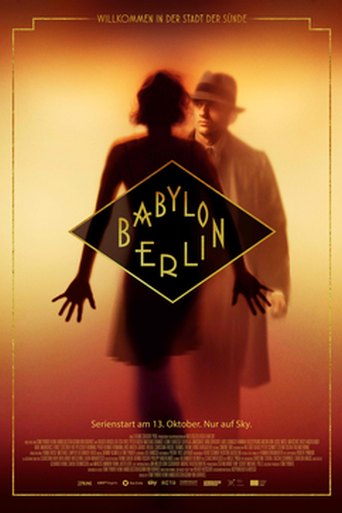
Babylon Berlin · Season 1 · Episode 1 · 13 October 2017
S1E1 Episode 1
A controlled, chilly pilot where therapy, police work, and one hidden film turn procedure into pressure.
THE MOMENT The Moka Efti nightclub sequence: a hundred extras, a full period orchestra, and the camera gliding through it all as if the scene is both celebration and funeral.
Detective Gereon Rath arrives in Berlin from Cologne and is immediately swallowed by a city operating on three simultaneous frequencies: decadent surface, communist underground, and the shadow-government of the police and army. The premiere establishes the show's visual and sonic grammar - expressionist shadows, period music arranged with contemporary menace - before delivering a set piece that collapses all three...
Full episode analysis below. Spoiler-light verdict above.
Updated
A man is told to breathe calmly. A voice places him in Cologne, in a summer before the draft, and then the episode cuts toward a raid where order is shouted into a room that has already lost it. That is the pilot's cleanest move: it treats control as performance. Therapy controls memory. Police control bodies. Paperwork controls murder after the fact. The first hour does not explain the city by touring it. It shows systems trying to file, seize, name, or bury what keeps slipping loose.
BollyAI's read: "Episode 1" is a strong pilot because it knows procedure can be mood. Its weakness comes from the same instinct pushed too hard. The hour withholds so much connective tissue that a few beats register as machinery before they register as drama.
The Room Opens Before the Case Does
The opening hypnosis sequence is a smart doorway because it refuses the usual pilot comfort of clean orientation. The guide tells the subject to breathe calmly, then anchors him to Cologne and a pre-draft summer. Before the hour gives a case, it gives a mind being handled.
That matters because Franz enters the episode caught between resistance and dependence. He wants to avoid being controlled in therapy, yet agrees to try again and is still not off the drugs. The episode does not underline the conflict. The set-up is enough. He is trying to push back against one method while relying on another form of management to survive it.
The pilot's best early choice is its flatness. The guide's calm does more work than a dramatic outburst would. Calm is the threat here. It creates a private procedural space before the police procedural begins, and the rhyme is sharp: the mind is being searched before the room is raided. Every institution in this episode wants access. Some use breath. Some use files. Some use force.
A Raid That Treats Panic Like Inventory
When the raid begins, the episode shifts from inner control to public control. The command that the show is over turns spectacle into evidence. The long stretches of silence around the raid give the sequence its bite. The room is not exploding into chaos. It is being reorganised.
The scene's tension comes from the mismatch between human embarrassment and institutional appetite. Someone asking whether another person has the runs during the scene change gives the episode a grubby human detail, the kind that keeps the raid from becoming noir wallpaper. Bodies still interrupt the plot. Stomachs, fear, sweat, and awkwardness keep leaking into the machinery.
That is where the pilot starts to reveal its method. It does not separate the sordid from the administrative. The raid is the first step in a chain of confiscation, cataloguing, and consequence. The episode is already training the viewer to ask where a piece of material will end up, who holds it, who hides it, and who pays when it goes missing.
The limitation: the early movement is dense. The dialogue climbs quickly through the raid and into headquarters, and the pilot occasionally trusts atmosphere to bridge gaps that need more shape. The mood convinces. The map stays deliberately incomplete.
Murder Becomes a Filing System
The police HQ material is where "Episode 1" shows its nerve. Instead of racing from raid to chase, it spends time on the photography archive of the homicide squad. That could be dead air in a weaker pilot. Here, it becomes a thesis scene.
Gennat wants a systematic catchword register of murder cases, and he has requested descriptions of crimes from the staff. That detail turns murder into language, then language into retrieval. The goal is to look for parallels, which means the institution is trying to make violence searchable.
BollyAI's read: this is the hour's most revealing procedural idea. The police are hunting criminals and building a memory machine. The hypnosis scene plants one version of memory, fragile and guided. The archive offers another, bureaucratic and organised. Put them together and the episode starts to look less like a simple case-opener than a story about who gets to arrange the past.
The colleague asking what is in it for him and being offered a kiss adds useful crookedness to the workplace texture. Even the rational system runs on barter, charm, and small personal leverage. The episode understands that institutions are never clean because people are never clean inside them.
Still, the archive sequence risks cooling the hour. Its ideas are strong, but the pilot asks for patience before it has fully attached every process to a face. The craft is confident. The emotional hook is still catching up.
König's Film Is the Pilot's Sharpest Fuse
The film plot gives the episode its most direct engine. König wants to keep the film for personal money, and someone later says he put one film aside. That choice is clean, selfish, and dangerous. It also gives the pilot a physical object that can carry guilt from one scene to another.
Franz's therapy explanation tightens the knot. He wants to say it was not his fault, and the reason he gives is that König kept the film instead of destroying it. That contradiction does not absolve him. It redirects blame. The episode plants a useful moral blur: responsibility can be shared, delayed, misfiled, or passed along, but it does not disappear.
Then comes the escalation at the therapy institute: König has been taken. The timing matters. The episode places that threat immediately after therapy dialogue, so Franz's inner defence and the outer danger collide. He can explain the mistake, but the world is already moving faster than his explanation.
This is where the pilot's structure works best. Hypnosis, raid, archive, and film are different kinds of handling. A person is handled. A room is handled. Evidence is handled. A murder file is handled. König's mistake cuts through all of that because one bad private decision can break an entire operation. The hour's paranoia is practical, not decorative.
The Train Crosses the Border
The late rally announcement that the train crossed the border gives the episode its widest frame. After so much attention to rooms, files, and films, the border line opens the scale. Something has moved. Something organised is in motion. The pilot does not spell out the full consequence yet. It only has to place that movement beside the smaller failures of control already on display.
That is the episode's season-arc promise: the private mishandling of a film and the public movement of a train may belong to the same city logic, where evidence, money, memory, and power all travel through systems that people pretend they command. The first hour earns its slot by planting questions with objects and procedures rather than speeches.
The risk is opacity. "Episode 1" sometimes behaves like a locked cabinet and calls that style. The viewer gets strong textures and clear pressure points, but several transitions stay more intriguing than satisfying. The hour is better at creating momentum than giving emotional entry.
Even so, the confidence holds. The pilot trusts process, silence, and ugly little bargains. It begins with a guided memory and ends with a border crossing, a move that enlarges the story without dropping the pressure built in smaller rooms.
The Verdict
"Episode 1" is a good pilot with a stern idea at its centre: control is everywhere, and it is failing in different ways. The hypnosis opening, the raid, Gennat's archive plan, Franz's therapy conflict, and König's hidden film all push the same argument from different angles. The episode is strongest when procedure becomes character, especially in the archive and film material. It is weaker when the withholding gets too heavy and the connective tissue thins out.
BollyAI's score: 8.0. The hour has style without begging for attention, and its best beats make paperwork feel dangerous. As a season opener, it plants clean open loops around the film, the catchword register, Franz's accountability, and the border-crossing train.
"An astonishing opening hour that announces a new kind of historical drama - one that uses beauty to implicate us in catastrophe."
Rotten Tomatoes (critics consensus)