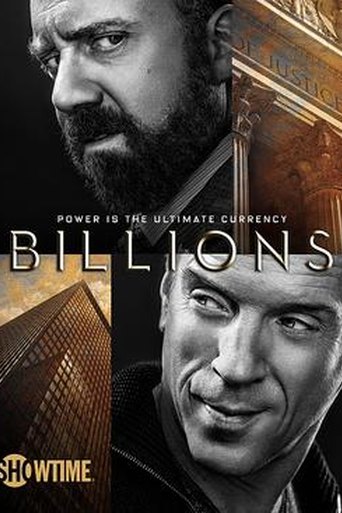
Billions · Season 1 · Episode 1 · 17 January 2016
S1E1 Pilot
A dense, muscular pilot where pressure is the language, and Skip’s death makes every earlier tactic feel expensive.
THE MOMENT The first scene - played entirely for character revelation rather than shock value - signals that Billions will be smarter about its provocations than its premise implies.
The pilot establishes the Chuck-Axe combat engine with full efficiency: a BDSM scene that immediately declares the show's willingness to transgress, a wiretap investigation that maps the legal cat-and-mouse, and two lead performances of extraordinary containment. The first hour does not waste a minute establishing the show's pleasure principle.
Full episode analysis below. Spoiler-light verdict above.
Updated
Skip Wolkowska is offered a way out, then loses it. The pilot spends most of its hour in rooms where men talk as if outcomes can be priced, delayed, shaped, or forced. Then a reporter calls with the cleanest, ugliest result in the episode: Skip is dead. That ending gives Billions its signature. Power arrives as conversation. Consequence arrives when the room has already moved on.
The hour’s strongest idea is simple: Chuck Rhoades and Bobby Axelrod sit on opposite sides of the legal line, yet they share a professional language of pressure. The pilot works because it refuses to make that echo polite.
A Fuck-Up-Free World
The opening tone is all discipline. Michael is told the office "is a fuck-up-free zone," and the line gives the pilot its operating system. Every institution here claims to have rules. Every rule exists because someone expects a mistake, a betrayal, or a leak.
That is why the early investigation chatter matters. Kim reports progress on open investigations, Spyros arrives at an inconvenient moment, and the episode chooses density over hand-holding. Conversation feels like combat prep. Information moves fast, names arrive before emotional context, and the audience is dropped into a machine already running hot.
The risk is visible. Dense dialogue can become noise when a pilot is still teaching the board. Billions occasionally pushes that edge in the early stretch, especially when investigations, market instincts, and office hierarchy collide before the characters have settled. But the pace has a purpose. The episode makes power look like a room where everyone talks because the first person to pause may lose.
That zero-breath feeling carries through the hour. There are few soft landings, and almost no scene sits around admiring itself. The pilot uses momentum as intimidation.
Axe Smells the Slide Before the Room Does
The first major Bobby Axelrod beat is instinct sharpened into aggression. He decides a trade is bad and pushes a short because the stock will slide after news. In one move, the pilot tells us how Axe thinks: he wants to monetize uncertainty before anyone else can name it.
The key phrase is spare: "In fact, short." No speech, no moral costume, no villain lighting. The line lands because it turns hesitation into action. Axe hears opportunity and converts it into pressure. The show defines him through decision speed.
The beat sharpens beside the legal material. Axe’s world and Chuck’s world use different tools, but the episode cuts them together through behavior. One room talks investigations and irreversible prosecutorial outcomes. Another talks markets and slides. Everyone is trying to get ahead of an event before it becomes public fact.
The pilot’s handling of Axe is canny because it avoids making him a simple money monster. He manages defense strategy, challenges plans, and tries to proceed despite warnings about the beach house. That gives him texture: appetite with calculation, confidence with irritation. He wants the room to accept that his read is better than everyone else’s.
The limitation shows too. Axe is forceful before he is fully complicated. The pilot gives him energy and tactical intelligence, while the inner cost of that intelligence remains less developed than the machinery around him. The show knows what he does. It is still beginning to show what he cannot stop doing.
Chuck’s Justice Has a Lever Under It
Chuck Rhoades gets the pilot’s cleanest moral line and its most revealing contradiction. When he rejects the leniency proposal, he says, "You don't buy your way out of justice here." As a declaration, it is hard, satisfying, and politically useful. As character writing, it is a trap set under his feet.
Chuck wants to be seen as firm on financial crime. He rejects the idea that a fine and house arrest should purchase mercy. That stance gives the hour its ideological center. Money has warped the room, and Chuck positions himself as the man who will not let it buy the exit.
Billions gets more interesting when the stance curdles. Chuck opposes leniency by payment while orchestrating pressure through leverage, including bringing Skip’s father into the room. He refuses one kind of transaction while using another kind of force. The episode does not need him to be a cartoon hypocrite. It only needs him to believe his pressure is cleaner because it serves justice.
That is the pilot’s best dramatic engine. Institutions do not become ruthless only when bad men enter them. They become ruthless when good outcomes are used to justify ugly methods. Chuck’s certainty is compelling, but the hour makes sure it carries a cost before the credits.
The argument over prosecuting Spyros also sharpens this. The risk is framed around irreversible outcomes, which puts caution and ego in the same room. Spyros wants his SEC trail taken seriously, asserts a direct conflict with Axe, and insists he knows the right thing. Chuck’s problem is whether the case can be built, and whether anyone in this ecosystem can act without turning his own importance into evidence.
The Beach House Becomes a Weapon
The $83 million beach house rumor is exactly the kind of object a pilot loves because it makes ideology visible. A number that large can be a purchase, a provocation, a headline, or a dare depending on who says it. Here, it becomes leverage almost instantly.
A U.S. attorney is told about the rumor, and later a team member is told to get Orrin Bach to warn Axe away from the house. The instruction plants the subplot cleanly. Property has become optics, escalation, and control over the public meaning of a rich man’s desire.
Axe trying to proceed despite warnings gives the episode a strong middle gear. The house is a character test because it is unnecessary in the strict tactical sense. If buying it inflames legal or public pressure, restraint would be the clever play. But restraint is not the same as control, and Axe’s presence in the pilot depends on refusing to let enemies set his boundaries.
That is where Billions finds its early juice. The house is blunt, but useful. It takes abstract conflict and pins it to an address, a price tag, a rumor, and a warning. The show needs that concreteness because so much of the episode lives in strategic talk. The beach house gives the legal war a shape.
The subplot also exposes the pilot’s appetite for brinkmanship. Everyone knows the move may escalate. Everyone keeps pushing anyway. The hour cares less about whether these men understand risk than whether understanding risk has any power over them.
The Call That Makes the Pilot Pay
The final shock works because the episode has spent the hour making consequences sound negotiable. Deals can be rejected. Trades can be reversed or exploited. Warnings can be ignored. Prosecutions can be argued. Then the reporter calls: Skip Wolkowska committed suicide.
The cut is abrupt by design. The line turns legal posture into human outcome, and the pilot is smart enough not to soften the impact with extra ceremony. Skip wanted leniency or reduced consequences. He did not get them. By the end, the machinery has produced a death.
That does not make Chuck solely responsible in a simplistic way, and the episode is stronger for avoiding that shape. The harsher point is that systems of pressure can create outcomes no single participant fully intended, then leave everyone arguing over whether intention is enough of a defense. Chuck’s earlier certainty now has blood near it. Axe’s aggression sits inside a larger climate of retaliation and exposure. Spyros’s information channels remain an open threat. The Norton beach house still hangs there, absurd and dangerous.
As a pilot, "Pilot" does the job with swagger and some overload. Its dialogue can crowd the frame before the emotional architecture settles. But the spine is strong: a legal fight, a public provocation, and a corpse on the moral ledger.
The Verdict
Billions begins with a pilot that trusts speed, pressure, and contradiction more than conventional setup. The episode is overpacked in its early investigation clusters, but that compression gives the world its charge. Chuck’s refusal to let money purchase justice would be enough for a flatter show. Here, the hour immediately dirties it with leverage. Axe’s market instinct would be enough for a flashier show. Here, it is tied to warnings, defense strategy, and the beach house provocation. The ending is the clincher: Skip’s death turns argument into consequence and gives the season a hard moral debt to collect. BollyAI's read: a muscular, talk-heavy opener with one excellent final cut of cruelty.