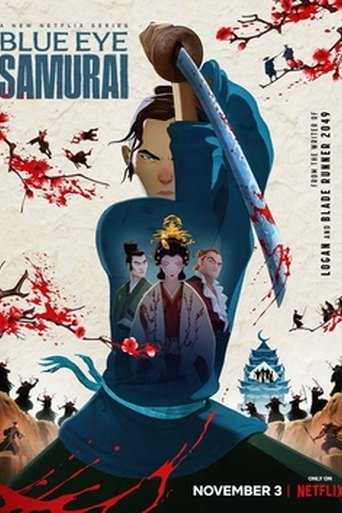
Blue Eye Samurai · Season 1 · Episode 1 · 3 November 2023
S1E1 Hamster and Snake
A dense, sharp premiere where a filthy gun, a desperate apprentice, and guarded secrets make pursuit feel personal.
THE MOMENT The reveal of Mizu's eyes in a moment of vulnerability - the visual that crystallises what the entire series is about: what the world sees and what it refuses to see.
The premiere establishes Mizu's concealed identity and her singular purpose in a Japan formally closed to outsiders. The opening action sequence announces the series' combat aesthetic immediately: fluid, bloody, and precisely choreographed. By the episode's end the scope of Mizu's quest and the cost she has already paid for it are both fully in frame.
Full episode analysis below. Spoiler-light verdict above.
Updated
The gun is filthy. Hachiman the Flesh-Trader refuses it, then turns the room into an interrogation. He does not want an object. He wants the chain behind it: buyer, seller, black-market route, European weapon. That is the hour's cleanest promise. Violence matters less than the path that brought it here. "Hamster and Snake" works best when every person becomes a lead to someone worse, every plea becomes a bargain, and every silence becomes a door the episode leaves half-open.
A Filthy Gun Makes the World Smaller
The premiere understands the value of a dirty object. Hachiman refusing the gun is a sharper opening move than any speech because it gives the world a system before it gives it mythology. Someone bought it. Someone sold it. Someone knows who moved it. The demand, "Tell me now," makes the scene transactional, ugly, and useful. Information is the real weapon here.
That matters because the hour keeps tying character to pursuit. Hachiman wants the seller. The samurai is close enough to black-market names for a dojo master to be questioned later about Heiji Shindo. The episode does not explain the whole network at once. It plants a route: weapon, merchant, protected brother, unreachable target. That route gives the premiere forward motion without pretending the destination is simple.
The tonal swing around the edges helps. A woman can boast of bad tea and great soba, then order customers to eat, and the show still feels dangerous because the joke has teeth. The line about the heavens throwing treasure lands like a small blessing inside a hard world. Food, filth, trade, and interrogation belong to the same economy.
The Apprentice Arrives With a Death Wish
The lost boy could have been a cute tagalong. The episode makes him more troublesome. Blind beggar boy asks to become an apprentice after explaining how he got lost and learned the forest, then states the desire plainly: "Be a samurai, like you." It is a simple line with a dangerous verb hidden inside it. He does not ask to be saved. He asks to be shaped.
That distinction gives the character bite. He wants protection, and he begs to protect Swordfather from time and harm, but his larger need is a route toward revenge. He wants to get stronger. He wants a way to reach the men he seeks. The contradiction is the point. He asks for help with violence while asking to be trusted as someone worth keeping close. He is needy, but he is not soft. He is lost, but he has already learned how to survive.
The hour earns its emotional charge by letting that request stay uncomfortable. When the boy later says he knows why he is not wanted around but insists he can be trusted, the plea carries more weight because the episode has not cleaned him up. He arrives carrying purpose, shame, usefulness, and a secret. The boy is a problem with a pulse.
Secrets Stay in the Dojo
Master Eiji gives the premiere its best sense of guarded authority. He controls the terms of access. The dossier frames him as someone who wants the dojo's secrets protected and training kept controlled, and his actions match that: refusal, containment, and careful answers when questioned about Heiji Shindo.
That controlled posture matters because the episode is built around people forcing doors open. Hachiman presses for the gun seller. The boy presses for apprenticeship. The samurai presses toward a black-market merchant. Swordfather presses for truth before parting. Master Eiji resists that pressure by making the dojo feel like a place where knowledge has rules. He does not spill the world out for convenience.
The craft is strongest when the premiere lets these confrontations breathe after the early density. Heavy dialogue clusters early, then broader pauses and long silences take over. That rhythm suits the material. The first movement throws names, demands, and bargains into the air. The later stretches let doctrine and travel carry the weight.
The weakness sits there too. The early exchanges crowd the hour before the emotional geometry fully settles. The show has a lot to load. At times, it loads with visible effort.
The Lie Is the Real Burden
Swordfather's most interesting role is moral pressure. He wants protection and a truthful path, and he pushes the seeker forward. The key line is plain. They cannot part in a lie. The boy must keep the burden. That turns honesty into action. A secret becomes something carried.
The episode uses that idea to sharpen the boy's central contradiction. He wants the path to revenge, yet he also has something to confess. He asks for closeness while knowing that closeness has a cost. His insistence that he can be trusted matters because the hour has already established trust as a dangerous currency. In this world, names lead to merchants, merchants lead to protected men, and protection can become a trap.
This is where "Hamster and Snake" finds its spine. The title suggests small creature and predator, but the episode is less interested in assigning those roles cleanly than in watching people misread one another. The boy looks helpless and arrives with a mission. Swordfather sounds like a guardian and becomes a test. The samurai's path looks solitary, yet the hour keeps attaching people to it.
The Four Fangs Give the Ending Teeth
The late decision to send The Four Fangs after the samurai is a smart premiere move because it converts investigation into retaliation. Until then, the episode's open loops pull forward through questions. Where is Heiji Shindo? Why is he protected? Why does Swordfather say the boy will not find what he seeks at his side? What does trust require?
The Four Fangs give those questions a body coming down the road.
That escalation keeps the episode from ending as setup. A plan is made. A target is identified. Consequence starts moving. The samurai's defeat of students has produced an answer from power, and that answer has a name sharp enough to stick. The phrase does plenty of work before anyone explains it.
Still, the hour's ambition makes the premiere slightly uneven. The gun-seller investigation, apprentice plea, dojo secrecy, Swordfather's truth demand, and retaliation setup all compete for first-episode space. The best parts are clean and confident. The connecting tissue sometimes has to hurry. But the hurrying rarely empties the scenes, because each major beat carries a concrete want. Hachiman wants a seller. The boy wants a path. Master Eiji wants control. Swordfather wants truth. That is enough engine for a first hour.
The Verdict
"Hamster and Snake" is a strong premiere because it builds the season's chase through wants instead of lore dumps. A filthy gun opens the market of violence. A lost boy turns apprenticeship into a threat. A dojo master treats secrets like property. Swordfather makes truth feel heavier than training. The flaw is density: the early dialogue works hard enough that the seams show, especially while the hour is still teaching its rules. But the structure holds. This is a confident opening chapter with a nasty little engine under it, one that plants Heiji Shindo, The Four Fangs, and the boy's lie as season fuel without simplifying any of them.