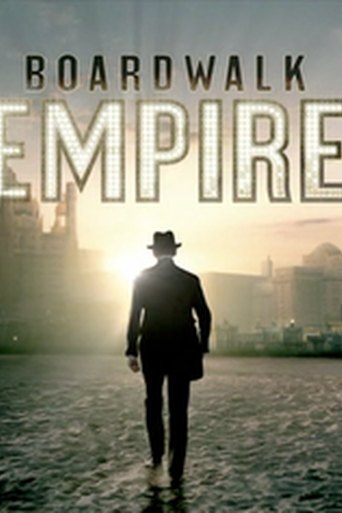
Boardwalk Empire · Season 1 · Episode 1 · 19 September 2010
S1E1 Boardwalk Empire
A sharp pilot where Nucky sells progress in public while his private machinery starts returning bodies with names.
THE MOMENT Nucky's speech to the Temperance League before the cameras pull back to reveal what he actually does - the show's central irony stated without a word of explanation.
The Scorsese-directed pilot establishes Atlantic City as a world unto itself - the long tracking shot through the boardwalk hotel establishing the geography and the political ecology in a single unbroken movement. Buscemi's Nucky is introduced as a man who has made himself necessary to everyone, which is both his power and his exposure.
Full episode analysis below. Spoiler-light verdict above.
Updated
A confrontation begins with a command: "Get 'em up! Up!" The line is ugly, practical, and perfectly placed. This pilot introduces power as a body being forced into position. Minutes later, Nucky Thompson stands in public and sells Prohibition as progress. That is the hour's argument in miniature. Atlantic City is being dressed up as civic virtue while violence waits just off the boardwalk. The episode works because Nucky's gift and his rot come from the same skill. He can organise a room. He can also organise distance.
Progress With a Knife Under the Table
Nucky's public line is clean enough to fit on a campaign card. Enoch Thompson declares, "Prohibition means progress." The pilot quickly turns that sentence into an operating manual for hypocrisy. Prohibition is coming, liquor is becoming illegal, and Nucky's instinct is logistics. He wants Atlantic City kept wet, and the episode frames that desire as politics under the cover of civic service.
The opening movement has a deliberate split personality. A woman recites an ode that begins, "Coward, monster, vicious brute," and the line hangs over the hour like a warning label. The public stage is full of uplift. The private machinery is already dirty. Nucky does not need to look like a gangster in every scene because the writing gives him a better trick: he looks like the man who knows where every gangster, official, hotel guest, and errand should stand.
That is why the pilot's pace matters. It lets speeches and waiting rooms do damage. The long stretches give Nucky room to appear charming, necessary, almost civic. Then the sudden confrontations cut through the ceremony. Progress is the slogan. Control is the product.
The Woman Waiting Over an Hour
The pregnant woman waiting to see Nucky is the pilot's first ethical bruise. Someone tells him, "There's a lady waiting to see you. She's been waiting over an hour." On paper, it is a scheduling problem. In the episode's design, it tests what Nucky's power is for.
The hour handles the interruption well. It places personal urgency beside public ceremony and lets the contrast work. Nucky's world depends on constant access to him, but access is rationed. Who gets a meeting, who waits, who is introduced at the hotel, who is pushed toward a brother when trouble starts: these are the pilot's real power moves.
That waiting woman also gives the episode a sharper edge than a straight bootlegging setup would have had. The liquor plot could have played as underworld architecture. Instead, the hour keeps returning to the human cost of systems built on delay, delegation, and selective attention. The later open question around Mrs. Schroeder's injury and the lost child deepens that design. The pilot plants pain before it explains every connection, giving the season a wound to investigate rather than a puzzle box to admire.
The limitation is that the episode is sometimes more patient than generous. It withholds enough around the roadside disaster and the woman's suffering that the emotional line has to compete with the mechanics. Still, the waiting-room beat earns its place because it exposes Nucky's kingdom from the side door. Empire, here, is measured in who has to sit outside.
Jimmy Wants a Door, Not a Leash
Jimmy Darmody enters the hour with hunger built into him. He wants opportunity, and the pilot uses that desire as the pressure point beneath Nucky's polished command structure. Jimmy wants motion. Nucky wants arrangement. The collision is inevitable because they understand the same world differently.
The hotel introductions matter in that context. Nucky arranges guests to meet, and the scene shows his preferred method of power: rooms, timing, access. Jimmy's ambition does not fit neatly into that choreography. He is close enough to the operation to matter and far enough from the top to resent the distance. That makes him useful. It also makes him volatile.
The violent gag around the formaldehyde cry is where the pilot's comedy curdles. The line "Formaldehyde, huh?" lands as a grotesque spark, then attacks follow. That tonal switch is one of the hour's better moves. Criminal masculinity often sells itself as a joke right until someone bleeds. The scene also helps define Jimmy's lane: danger arrives through men testing each other, bad plans, and one more escalation nobody wants to own after it goes wrong.
By the time Jimmy is pulled toward the consequences after the planned load, the pilot has made his dissatisfaction active. He is a fault line inside Nucky's system.
Van Alden Spots the Loose Thread
Agent Van Alden brings a different kind of pressure. When he questions why James Darmody works for Thompson, the pilot briefly changes its grammar. Nucky's world runs on favors, access, and plausible distance. Van Alden's world wants statements, categories, and leverage. His attempt to recruit James for enforcement against illegal liquor gives the hour its clearest external threat.
The scene works because Van Alden is looking for a weak joint, not chasing a vague crime wave. Jimmy's connection to Nucky gives him exactly that. The pilot's central contradiction tightens here: Nucky wants to control illegal liquor and shield the business from consequences, but his structure creates intermediaries who can be pressured, tempted, or blamed.
That contradiction snaps into focus with Nucky's instruction: "If you get in trouble, don't call me. You call my brother." It is a sharp line of character because it sounds like help and functions like insulation. Nucky is routing liability. The brother becomes a buffer, the operation remains protected, and Nucky preserves the clean surface he needs for speeches and hotel rooms.
Van Alden's presence also gives the pilot a useful chill. He does not need to dominate the hour. His value is directional. He points at the place Nucky's machine can crack. In a pilot crowded with public performance and private appetite, Van Alden is the man asking why the pieces are arranged this way.
Bodies on the Road, Doors in the Bedroom
The final stretch turns the hour's arrangements into fallout. A reporter states that a fisherman's net body has been identified as Hans Schroeder, and the detail is brutally efficient. The empire's hidden violence has entered public language. A body has a name. The sea, the road, the load, the household injury: the pilot does not tie every knot, but it makes clear that Nucky's distance has limits.
That is where Lucy Danziger becomes more than a side complication. Her need for private attention, and her blocking of access when Nucky tries to pull Eddie and Jimmy into the matter, turns domestic space into another pressure point. Nucky's obligations do not wait outside the bedroom. Business intrudes, desire interrupts business, then violence demands attention again. The hour keeps trapping him between rooms he thinks he controls.
The roadside massacre open loop is the pilot's biggest engine and its messiest choice. The episode plants questions about who orchestrated it, how much each party knew about the liquor load, and what Jimmy's disappearance or misdirection changed. Those questions can propel the season, but the pilot occasionally stacks them in a way that blurs immediate impact. Mystery is useful. Fog has a cost.
Still, the closing identification of Hans Schroeder gives the hour a hard landing. Nucky's system is built on delegation, but the consequences refuse to stay delegated. The bodies are beginning to come back with names attached.
The Verdict
"Boardwalk Empire" is a confident pilot because it builds its criminal world through procedure before spectacle. The speeches, hotel introductions, waiting rooms, blocked doors, and official questioning all point toward one idea: Nucky Thompson's power depends on controlling access while denying proximity to damage. The episode's best scenes understand that command can sound polite, civic, even generous, until the bill arrives in blood.
The hour is not flawless. Some of the massacre mechanics are held back so tightly that the emotional force has to fight the plotting. But the craft is strong, the character contradictions are clear, and the final body identification gives the season a nasty hook. This is a pilot with a full map in its pocket and dirt already under its nails.