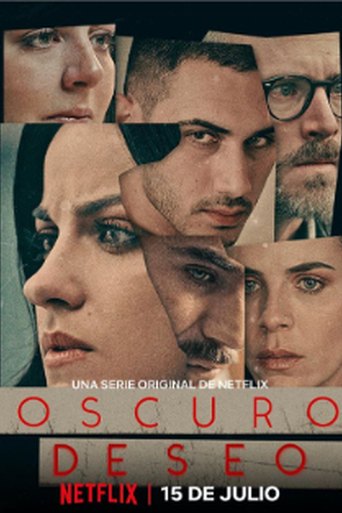
Dark Desire · Season 1 · Episode 1 · 15 July 2020
S1E1 It's Just Sex
A provocative opener with clean thematic wiring, dragged down when its lecture block explains what the drama already planted.
THE MOMENT Alma and Dario's first meeting at the hotel - the show announces its genre contract clearly and Perroni conveys exactly how much Alma knows she is making a mistake.
The premiere establishes Alma's constrained domestic life and the weekend encounter with Dario efficiently. The erotic thriller mechanics are deployed without apology, and Maite Perroni's performance suggests more psychological depth than the genre typically requires. The hook functions as intended.
Full episode analysis below. Spoiler-light verdict above.
Updated
The episode begins with death before it reaches sex. Zoe says “Memento mori” to her mother, then explains her pull toward postmortem images with the casual clarity of someone already past other people’s discomfort. That matters. Dark Desire opens its season by placing temptation beside mortality rather than selling it as glamour. The premiere works best when desire, study, spectacle, and violence contaminate one another. It weakens when it underlines the syllabus in red.
Death Is the First Flirtation
The smartest move in “Episode 1” is that it begins with routine, not scandal. Alma’s mother asks her to send a study plan and book Classroom 10 for a seminar. It is a dry, functional beat, the kind of errand that pins a character inside ordinary life before the plot starts pressing on her.
Then Zoe arrives with death on her tongue. “Memento mori” gives the hour its frame. Her interest in postmortem images, along with her plan to become a medical examiner, pushes death out of the shadows and into the family room. Dark Desire is already announcing the kind of erotic thriller it wants to be, one where bodies carry evidence, desire, and harm at once.
That opening tension gives Alma a clean first outline. Around her, people discuss death with intellectual distance, but the episode is preparing to drag her into a mess where distance will fail. The seminar, the classroom, the medical examiner talk, and the later mention of femicide all belong to clean categories. The premiere’s engine is the dirtying of those categories. Alma begins as someone who can arrange and contain difficult subjects. Then the hour tests whether she can contain herself.
Brenda Lights the Match in the Rain
The rain-soaked arrival at Brenda’s place is the hour’s first proper swerve. Brenda invites Alma inside and asks for a Bloody Mary, exactly the kind of detail this premiere understands. A drink order becomes a tonal signal: red, messy, social, performative. The episode has moved from mortality as theory to appetite as strategy.
Brenda’s plan is blunt. She worries over infidelity, circles the figure of “the incorruptible and impeccable Mr. Judge,” and proposes a night out with the line, “Tonight, you and I will go hunting.” That word does heavy work. It turns sex into sport and marriage into bait. It also turns friendship into a mechanism for escalation. Brenda is staging a response to fear by manufacturing danger.
That contradiction gives her bite. She wants to manage anxiety through a controlled betrayal-adjacent performance, yet nothing about the episode’s rhythm suggests control will survive the night. This is where the premiere has its sharpest pulse: two women talking themselves from grievance to action, the conversation quickening until the decision feels triggered rather than chosen.
The criticism lands here too. Brenda’s push is dramatically effective, but it is heavy-handed. The hunting metaphor announces itself so loudly that the episode leaves little room for ambiguity in her role. She functions as spark and warning label in the same breath.
Alma’s No Is Already Compromised
Alma’s most interesting quality in the premiere is containment. She wants to avoid romantic entanglement, yet she goes along with Brenda’s plan. Later, after the night tilts into a hospital incident involving a man fainting in a hot tub, Alma’s immediate instinct is damage control. She wants Leonardo kept out of it, asking that he not be told.
That contradiction is the episode’s real hook. Alma wants the event boxed up, labelled, and hidden. The problem is that the hour has already shown how weak boxes are in this world. A seminar can become a thematic doorway. A casual drink can become a hunt. A private night can become a hospital incident. A secret can turn into a conversation at home before the person guarding it has finished deciding what the secret even means.
The central tension sits in that gap: Alma demands silence around Leonardo, then recounts the hospital incident at home. The inconsistency belongs to her character. She wants control, but her method of control is speech. She keeps explaining, reporting, and managing, as if the right version of events can stop the wrong consequences from forming.
Dark Desire understands the irony. Alma is surrounded by professional and academic language, by study plans and seminar rooms, but the night she enters cannot be handled like a lesson. The premiere’s best suspense comes from whether she can survive the narration of what happened.
The Lecture Says the Quiet Part Too Clearly
The late shift into the classroom gives the premiere its clearest theme and its clumsiest passage. When the professor speaks about gender-based violence and a femicide lacking in headlines, the episode pulls its private drama into a public framework. On paper, that is the right move. The hour has been arranging death, desire, jealousy, and gendered danger from the beginning. The lecture is the thesis stepping into the room.
The trouble is the shape of the shift. After the first half’s dense dialogue and quick escalations, the sustained lecture blocks feel blunt. The earlier scenes let meaning leak through behavior: Zoe’s fascination with postmortem images, Brenda’s hunting language, Alma’s panic over what Leonardo may learn. The classroom states the meaning directly.
The material still has value. The mention of femicide lacking in headlines gives the season a wider moral field and plants the question of what causes the professor will name next. The episode is clearly building more than a cheating spiral. It wants erotic-thriller machinery to sit beside structural violence.
Still, the craft is stronger when the show trusts scenes over statements. The classroom material gives the premiere seriousness. The earlier rain, drink, and hospital beats give it teeth.
The Verdict
“Episode 1” is a solid, charged opener with a clear argument: desire becomes dangerous here because everyone tries to intellectualize it, weaponize it, or hide it after the fact. The premiere’s strongest writing comes from contradiction. Zoe treats death as vocation. Brenda treats sex as strategy. Alma treats secrecy as administration, then proves how fragile that administration is.
The episode loses some edge when it moves into extended explanatory mode, but the thematic wiring is clean enough to keep the hour gripping. As a season-starter, it plants useful open loops: the seminar, the hospital incident, the unidentified man, Leonardo’s possible knowledge, and the lecture’s unfinished causes. BollyAI’s score: 7.0 out of 10.