ER · Season 1 · Episode 1 · 19 September 1994
S1E1 24 Hours
A tense, crowded pilot that finds character through pressure, even when its case load compresses the emotional aftershocks.
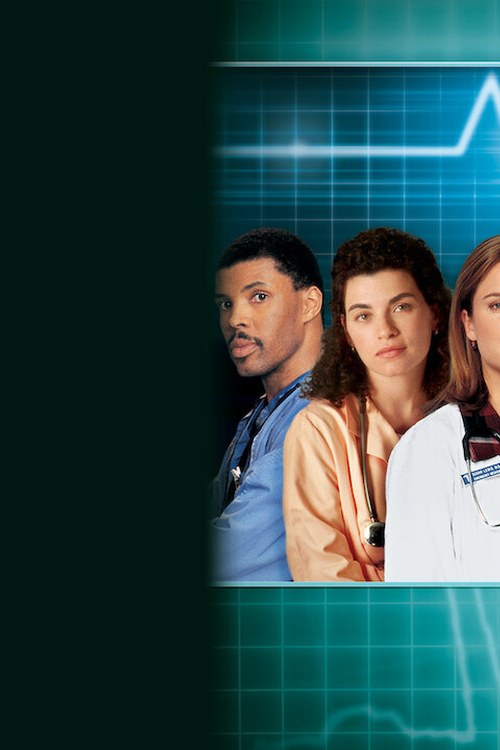
THE MOMENT The closing shot of the ER team regrouping after a catastrophic hour - exhausted, intact, ready for the next case. The show's whole emotional argument in one image.
The feature-length pilot drops viewers into Cook County ER without orientation, trusting them to find their footing amid overlapping crises. Michael Crichton's script moves with the speed of genuine emergency medicine. George Clooney's Doug Ross and Anthony Edwards' Mark Greene establish a dynamic that would define the show's entire run.
Full episode analysis below. Spoiler-light verdict above.
Updated
A delivery arrives for Dr. Greene, timed for five o'clock. Minutes later, the city breaks open: a construction building collapses in the Loop, and the unit has to stop behaving like a workplace and start behaving like a machine. The pilot states its terms quickly. This hospital comes into focus through orders, interruptions, triage, and bad news delivered before anyone gets a pause.
"24 Hours" works because it treats the emergency room as pressure first and personality second. The people emerge through what they do when the room refuses to wait.
The Shift Begins Before Anyone Is Ready
The pilot does not warm up. That timed delivery for Dr. Greene gives the opening a small domestic clock, then the collapse in the Loop blows the scale outward. The hour keeps returning to that contrast. The unit has schedules, errands, routines, and coffee complaints. The city keeps sending bodies through the door.
The construction-collapse news acts as the starter pistol. From there, the dialogue becomes procedural in the cleanest sense: "Give me an EKG, and X-ray of his chest, wrist and hand." The line is functional, almost bare, which is why it works. The show teaches its rhythm through commands. Someone needs a chest checked. Someone else needs an extremity handled. Nobody explains the system because the system is already moving.
That could become medical wallpaper, but the episode finds character inside the traffic. Greene's need to keep the unit focused and supported is embedded in the way he holds the floor when cases stack up. Leadership in this room means creating enough order for everyone else to survive the next five minutes.
The weakness is visible too. The hour is so dense with instructions that some early beats blur together. The pace sells the environment, but it limits how much emotional texture each patient can carry before the next alarm arrives. As a pilot strategy, the overload has purpose. The audience is dropped into a hospital, not invited into one.
Code Blue, No Ceremony
The first major escalation arrives with a woman coding. A staffer calls, "She's coding. Code blue! Call the time. It just happened." The sentence has no poetry in it, and the episode is better for that. It is all action and timestamp. A life changes status in a second, and the room's language narrows to what can be done.
This is where "24 Hours" separates itself from a simple workplace introduction. The pilot does not ask the emergency room to be inspirational. It asks it to be fast. The response to crisis is staffing priorities changing midstream. People move because the situation demands movement.
Then the episode follows the damage into another register: a son learns his father had a heart attack and could not be revived. The shift matters. The hospital's command language can push blood, equipment, and bodies into place, but it cannot make grief orderly. The hour's best early stretch is the collision between the institution's speed and the family's sudden stop.
Greene's place in that collision is important. The character map points to him wanting to keep the unit focused and supported, then setting a tone during a critical aftermath. The pilot plants that role with restraint. He is no miracle worker. He is a stabilizer inside a room built to destabilize everyone.
The episode's emotional method is blunt. It lets the medical machinery do its job, then lets the human consequence arrive a beat later. When it works, the result is sharp. When it misses, the hour has already moved on before the aftershock can spread.
Coffee, Exhaustion, and the Joke That Isn't a Joke
At 13 minutes in, the staff vent about grueling hours and the fact that they also have to make the coffee. It is a small complaint, but it tells the truth about the pilot's world better than a speech would. These people are dealing with codes, heart attacks, X-rays, collapsed buildings, and the petty insult of keeping the coffee going.
That workplace irritation keeps the episode from becoming a shrine to medical seriousness. "24 Hours" needs the complaint because it makes the unit feel inhabited. People under strain do not speak in theme statements. They gripe about the next task. They get annoyed by the unglamorous chore. They keep going.
The onboarding beat, marked by the guidance "Don't shake his hand. He's afraid of disease," adds useful texture. The instruction is oddly specific, and that specificity matters. It suggests a workplace full of rules that are not written on walls: who can be touched, who panics about what, who needs warning before a small interaction. The pilot's world expands through practical details.
This is also where the instruction-heavy style pays off as comedy without breaking tone. The humor does not pause the emergency-room engine for a joke. It comes from the absurdity that high-stress workplaces produce: life and death in one corner, coffee duty in another, disease anxiety somewhere in the hallway.
The pilot understands exhaustion as a system. The people inside it are tired, funny, clipped, and useful because they have to be.
Mr. Parker Wants an Answer the Episode Will Not Give Him
The Mr. Parker thread gives the pilot its clearest moral friction. He wants certainty about his condition. The doctor cannot confirm the diagnosis yet. Parker wants a definitive truth about whether he has cancer and how long he has to live, while the medical response leaves room for bronchoscopy and exploratory surgery discussion.
Then comes the hard line: "Six months to a year." It lands because the episode has established a world of rapid decisions. Here, speed becomes cruel. Parker asks how long he has, and the answer arrives with the brutal neatness of a range. Six months to a year. A life reduced to a bracket.
The episode is careful to keep certainty unstable. Parker's diagnosis cannot be confirmed yet, even as the conversation starts sounding like a sentence has already been passed. That tension gives the thread its strength. Medicine here means probability, procedure, and the unbearable human hunger for a clean answer.
This is where the pilot earns its heavier tone. The emergency cases create adrenaline, but Parker's uncertainty creates dread. After so much dense, instruction-heavy dialogue, even a limited pause can feel like the room has lost oxygen. The hour uses that pressure well.
The flaw is that Parker's thread has to compete with a crowded pilot. The emotional weight is real, but the episode cannot fully live inside it. Still, the open loop is strong. The lung-density workup matters because the pilot has made uncertainty the point.
The Room Becomes an Institution
Late in the episode, the battered-child case shifts the hospital from treatment space to reporting mechanism. The line "I'm gonna call Children And Family Services" is plain, but it changes the story being told. The unit is no longer only asking how to keep a body alive. It is asking what must happen when injury suggests harm outside the hospital walls.
That move broadens the pilot's moral map. A child-beating and burn-scar accusation cannot be solved with an X-ray, an EKG, or a confident order. The institution has to intervene, and the episode plants the question of what Children and Family Services will determine. It is a strong late beat because it reminds the hour that medicine does not end at diagnosis.
Peter also gets a pressure-defined introduction through the ruptured aneurysm operation thread. He wants help getting through it, argues, and proceeds with a plan to keep the patient alive. Again, the pilot defines character through action under strain. Peter's conflict is the immediate need to make a plan hold when the body in front of him may not.
The episode's larger design becomes visible here. It builds cases that test different parts of the same system: emergency response, family notification, long-term diagnosis, workplace fatigue, suspected abuse, surgical crisis. That is a lot for one hour, and the pileup occasionally makes the pilot feel more like a controlled collision than a clean dramatic arc.
But "24 Hours" is built as a shift, not a tidy single-case story. Its form matches its title. The open loops are unresolved cases, unsettled morale, and diagnoses still moving through procedure.
The Verdict
"24 Hours" is a strong pilot because it chooses velocity over explanation and lets character leak out through decisions. Greene's steadiness, Peter's surgical pressure, Parker's need for certainty, and the late Children and Family Services turn all serve the same argument: this room runs on action, but every action leaves a human remainder.
The episode has flaws. Its dense case load can compress feeling, and a few beats pass before they have time to bruise. But the craft holds where it counts. The pacing creates stress, the procedural language builds authority, and the open loops feel rooted in medical and institutional consequence. As a season opener, it plants a durable engine: crisis keeps arriving, and the drama sits in how the people inside the room keep setting the tone.