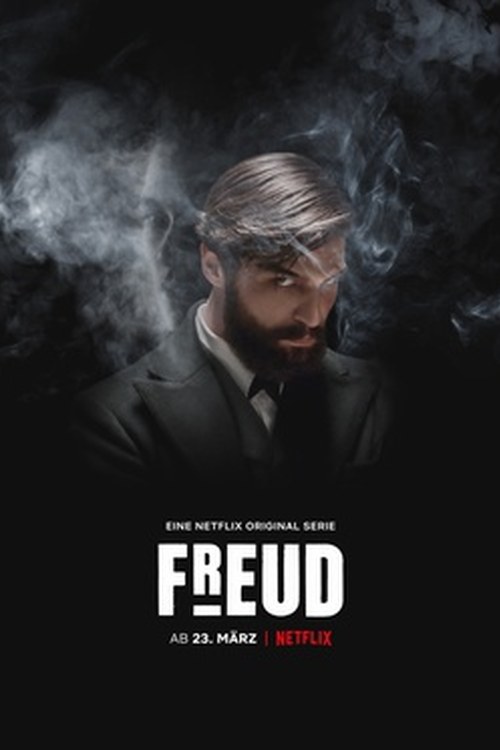
Freud · Season 1 · Episode 1 · 23 March 2020
S1E1 Hysteria
A nervy premiere with a strong hypnosis spine, dragged down when its genre shifts arrive sharper than its character grounding.
THE MOMENT Freud's first hypnosis session with Fleur - the moment the show signals it will pursue the occult more seriously than the psychology.
The premiere establishes the show's gonzo logic immediately: this is not a Freud biography but a supernatural procedural wearing Freud's name. Robert Finster plays him as manic, brilliant, and professionally marginalised - a credible interpretation that the show promptly launches into a murder mystery.
Full episode analysis below. Spoiler-light verdict above.
Updated
A voice takes control before the episode explains its rules. Unknown says, "You hear my voice and see the pendulum." The command is simple, almost clinical, and the premiere keeps returning to that shape: one person speaking, another yielding, memory bending under pressure. "Hysteria" works best when it treats hypnosis as a fight over authority. It weakens when it jumps from injury mystery to lecture-room theory, dinner-table banter, and séance panic without giving each turn enough room. This is a nervy, overstuffed opener with a real through-line: control.
The Pendulum Makes the First Move
The opening does the right thing for a show about hypnosis. It skips explanation and begins with command. The voice-and-pendulum exchange places the hour inside a ritual of attention, and that choice matters because the episode later keeps asking the same question in different settings. Who gets to name reality? The person remembering, the person diagnosing, or the person directing the scene?
That question tightens when the participant is pushed to shout Josephine's fate. "What did you shout? Shout it now" turns memory into performance. The episode is already suspicious of testimony because testimony can be staged, pressured, or reshaped. This is where "Hysteria" finds its strongest angle. Speech becomes an instrument that can heal, expose, distort, or trap.
The problem is volume. The premiere wants atmosphere, mystery, and intellectual stakes all at once. The neighbor's report of a past death scenario adds a procedural shadow. The injury beat that ends with "It's too late" brings mortality into the room. These are useful pressures, but the early stretch stacks them faster than it can sort them. The result is compelling friction rather than clean momentum. The hour has a pulse, then keeps changing the rhythm under its own feet.
That instability suits the subject to a point. Hypnosis should feel like a loss of footing. The danger is that the viewer starts tracking the show's maneuvers instead of the characters' fear. The premiere has a strong premise for dread, but its first act sometimes treats unease as something to accumulate rather than shape.
Lenore Refuses the Tear, Then Enters the Machine
Lenore gives the premiere its cleanest contradiction. She refuses forced emotional display. "No tears" is not a small preference in this episode. It is a defense of self-control. She wants to maintain that nothing sad has happened, which makes the later hypnosis-driven narrative feel like an attack on performance itself.
That is the clever part. The episode sets up a world where feeling can be demanded, staged, or extracted. Lenore's refusal sits against the instruction that someone will perform a charade, and her claim of agency is answered by a method designed to blur agency. When a character insists, "I'm not under hypnosis," the line carries a useful sting because the scene around it keeps certainty unstable.
The writing leans hard on the conceptual neatness of that contradiction. Lenore's resistance is sharper as an idea than as a lived emotional beat. The show knows what she represents: a person trying to control the terms of display. It has not given that control enough texture yet. Her scenes have tension, but the ache underneath remains underdeveloped.
Still, Lenore matters because she gives the premiere a human counterweight to Freud's argument. Without her, hypnosis could become a clever device or a period-specific intellectual tool. With her, it becomes invasive. The episode understands that being observed can be its own kind of pressure. It also understands that refusal can become part of the performance once other people decide how to interpret it.
Freud Turns Theory Into Theatre
Dr. Sigmund Freud enters the hour with a theatrical mission: he wants to change how influential physicians perceive hysteria by demonstrating hypnosis. That is a strong engine for a first episode because it turns medical theory into a public gamble. He has to perform his idea under the eyes of people whose judgment matters inside the story.
The lecture dinner material gives the episode a social gear before the formal theory arrives. "You can't sleep anyway" is a small, practical line, but it catches the pressure of preparation. Tomorrow is a stage for Freud's circle. Then the lecture pivot arrives with the phrase "Hysteria, poorly defined and multi-faced as it is," and the wording opens the door for the episode's central move. If the condition resists fixed definition, the method used to approach it becomes the drama.
That is where "Hysteria" has bite. Freud's hypnosis is not framed as a neutral tool. It is a method fighting other methods. Charcot's framing is rejected. Demonstration becomes argument. The patient or model becomes evidence. The episode understands that ideas on screen need bodies, rooms, timing, and risk.
The criticism is that the hour sometimes mistakes density for escalation. Dialogue does heavy lifting, then silence cuts in, then genre shifts yank the focus elsewhere. The ambition is clear. The transitions creak. Freud's scenes have charge because they make thought visible, but the surrounding structure keeps pulling that charge into adjacent mysteries before it can fully build.
The premiere is better when it lets Freud's argument create danger on its own. The possibility that a treatment can expose truth is interesting. The possibility that it can manufacture truth is better. "Hysteria" keeps both possibilities alive without resolving the ethics too early, and that restraint gives the episode its most durable tension.
The Séance Gives the Hour Its Fever
The final movement belongs to Miss Salomé, who wants help through hypnosis or diagnosis after being scared in the séance. Her presence pulls the premiere away from lecture-room combat and into a more feverish register. That shift is risky because the episode has already moved through mystery injury scenes, dinner preparation, and formal medical argument. By the time Miss Salomé reaches the hypnosis crisis, the hour is carrying a lot of furniture.
The ending works because it brings the premiere's controlling image back under pressure. A voice, a patient, a procedure, a memory. The command structure from the opening returns with higher stakes. During hypnosis, a shock condition is stated: there was no memory and no voice. That phrase hits the episode's obsession cleanly. If voice is the instrument, voicelessness is terror. If memory is the evidence, memory loss is a locked room.
Then the rupture comes: "Miss Salomé, you're waking up from the hypnosis!" The line plays less like a release than a break in containment. The episode plants several open loops with purpose. The Josephine memory may be manufactured or validated. The officer or Georg connected to Miss Horváth's death remains unresolved. Clara's fate during the hypnosis sequence is still unclear, as is its relation to Miss Salomé's memory.
That is sound premiere architecture. It leaves questions with shapes, not fog. The weakness is the climb into this point. Long silences and dense dialogue create atmosphere, but the escalation sometimes feels interrupted instead of tightened. The séance material also asks the show to absorb a different register just as the medical-theory conflict is gaining definition. The fever is effective. The timing is crowded.
The Verdict
"Hysteria" is a solid, jagged premiere with one strong governing idea: hypnosis is power before it becomes treatment. The episode opens with command, builds through Lenore's refusal, sharpens through Freud's public demonstration, and ends with Miss Salomé's hypnosis breaking into crisis. That through-line gives the hour more discipline than its genre-hopping surface suggests.
The craft is uneven. Dense dialogue, theory pivots, injury mystery, séance fear, and silent gaps create a stop-start rhythm that can feel heavier than the drama underneath. Yet the premiere plants real season questions and gives Freud's method a dangerous theatrical charge. As a first chapter, it earns interest without fully earning trust. BollyAI's score: 7.0.