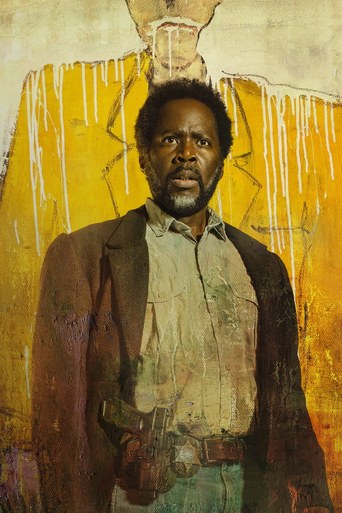
From · Season 2 · Episode 1 · 23 April 2023
S2E1 Strangers in a Strange Land
A tense opener turns mystery into rescue work, with strong dread, useful cracks, and a little too much scrambled urgency.
THE MOMENT A voice calling down into the pit where Boyd wakes: I can help you if you help me. The season's worst bargain, offered in its first hour.
The premiere answers season one's cliffhanger by making everything worse in three directions at once. A bus of new arrivals idles outside the diner during monster hours, nearly two minutes of the episode passing in paralyzed silence while they sit in the dark not knowing the rules. Donna, holding the town alone, makes her first command decision by shooting out...
Full episode analysis below. Spoiler-light verdict above.
Updated
The lights inside the diner do not flicker politely. They burst, and the room turns into a job site where panic has a timetable. People shout, hands move, circuit boards need saving, and nobody has the luxury of understanding the larger nightmare before the smaller one catches fire. That is the sharpest idea in "Strangers in a Strange Land." Escape may be a cosmic question, but survival is practical work. Secure the diner. Dig through debris. Get inside before sunset. Then ask what the town wants.
Hope Has a Bad Sense of Direction
The episode opens with dislocation before explanation. Characters realize they are on the same road, yet something is wrong, and that wrongness does more than any speech could. A road should promise movement. Here, it turns into a loop with manners. The trap still looks like infrastructure, which makes the first act land with a clean, nasty logic.
Boyd gives the premiere its clearest mission statement when he says, "The only way for us to go home is to wake everyone up." It is a leader's line from a man still resisting the full weight of leadership. That tension matters. Boyd wants to pull everyone toward home, but his reluctance to take charge leaves room for doubt. The show does not frame that hesitation as cowardice. It uses it as pressure. In a place this irrational, command depends less on knowing the answer than on sounding like the person who can get everyone through the next five minutes.
That uncertainty also keeps Boyd from becoming too clean a hero. He has purpose, but purpose does not give him control. The town keeps reducing authority to triage, and the premiere is strongest when it lets him operate inside that reduction. He cannot explain the loop. He can name a goal. He can move people toward it.
The song choice strengthens the mood. "A Hard Rain's Gonna Fall" does not need explanation. Its presence gives the hour an old, bruised omen, a warning carried through melody rather than plot. The premiere is direct about dread, but it places that dread well. The music arrives before the mechanics settle, so the emotional weather forms before the rules do.
The Diner Becomes a Fuse Box
The diner sequence is where the premiere finds its pulse. the room flips into emergency mode as lights explode and the survivors scramble to protect what can still be protected. The writing makes a sharp choice: exposition becomes labor. People are not standing around defining the threat. They are trying to stop the damage from multiplying.
That gives the scene a rough, convincing texture. The dialogue comes in fast bursts, the kind of shouted instruction that sounds less written than thrown across a room. The episode alternates between frantic, high-density exchanges and long silences, and this sequence is the clearest payoff for that pattern. Noise becomes panic. Silence becomes the bill.
The scene also clarifies how the town attacks people. It does not only send monsters. It creates conditions where ordinary systems fail at the worst possible moment. Lights blow. Wires matter. Timing becomes lethal. The result is a survival problem that feels mundane and unreal at once, which suits the show’s larger design. Terror comes through infrastructure as much as through teeth.
The weakness is clarity. The hour sometimes lets urgency crowd the frame, especially when the scramble gets so dense that the emotional geography blurs. Chaos can trap the characters without making the scene harder to read. "Strangers in a Strange Land" occasionally crosses that line. Still, the choice is defensible because the episode is building a town where knowledge never arrives cleanly. The diner does not become safe because someone explains it. It becomes safe because enough frightened people do the right small things in the right order.
Under the Town, Fear Gets an Address
Victor carries the episode's most frightening piece of information, and he delivers it like someone who hates knowing it. "We're underneath the town. This is where the monsters live." That line gives the nightmare architecture. The danger is no longer only outside, in the dark, or approaching from the trees. It has a bedroom. It sleeps beneath the characters' feet.
Victor's uncertainty gives the reveal its edge. He wants to guide others to safety, but he is scared and unsure of the way. That is more useful than making him a simple guide figure. He knows enough to help and enough to be terrified. The episode keeps him from turning into a cheat code, which is crucial. If Victor became a walking answer key, the town would shrink. Instead, his knowledge makes the space larger and worse.
The underground setting also changes the threat’s texture. Monsters are no longer just visitors from the dark. They belong somewhere. They occupy a hidden layer of the town, which makes every floorboard feel suspect and every route feel temporary. The show gets real mileage from that spatial violation. Safety above ground starts to look provisional because the danger has roots.
The weird symbol on the ceiling and the mention of the boy in white widen that unease without resolving it. The premiere plants them as open loops, not decorative mysteries. That distinction matters. A symbol can become cheap if it only asks for screenshot attention. Here, because it appears alongside the revelation of the monsters' sleeping place, it feels tied to the town's physical logic. The hour does not solve the puzzle. It makes the puzzle feel inhabited.
Rescue Is the Only Leadership Left
The second half turns survival into coordination. A woman is trapped in a basement. Julie wants to find her father and help her mother, yet she ends up helping organize rescue efforts. That shift is one of the premiere's better character moves because it does not stop to announce growth. Julie acts because the situation gives her no clean private lane. Personal fear and public necessity collide, and public necessity wins for the moment.
Jim becomes the body at the center of that collision. He wants to survive the collapse, then ends up injured, suffering a seizure, and needing to be rescued from debris. The episode uses his rescue to narrow the clock. By the time the warning lands that anyone outside after sunset will die, every delay has become a threat. The rescue is no longer only about getting Jim out. It is about beating the town's schedule.
The sequence works because it treats rescue as a group problem rather than a spotlight moment. No single person owns the effort for long. Instructions pass from one frightened mouth to another. Strength matters, but so does listening. The town has already made knowledge unstable, so cooperation becomes the closest thing anyone has to a tool.
This is where the premiere's uneven pacing helps more than it hurts. The long lull near the 38-minute mark does not drain tension; it makes the next push feel heavier. Still, the episode repeats its emergency rhythm enough that a sharper cut might have hit harder. Dig, warn, hurry, repeat can become a loop of its own. The final movement avoids that trap by giving the group a concrete finish line: get inside the diner before night takes the choice away.
The Verdict
"Strangers in a Strange Land" is a strong, slightly ragged season opener that understands how to turn mystery into momentum. Its best passages are built from immediate tasks: protect the diner, guide the frightened, rescue the trapped, reach shelter before sunset. Boyd's uncertain leadership gives the hour a human crack, Victor's underground reveal gives the town a nastier shape, and Julie's rescue coordination lets panic become action.
The faults are real. Some frantic stretches blur more than they sharpen, and the rhythm can feel uneven as the episode swings from shouting to silence. That unevenness mostly suits the design. As a season opener, it plants the wake-everyone-up mission, the symbol, the boy in white, and the question of escape without letting the puzzle smother the people stuck inside it.