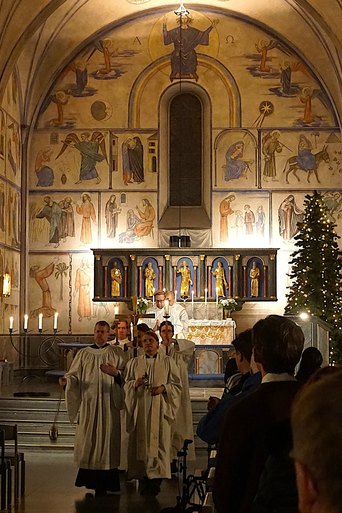
Midnight Mass · Season 1 · Episode 1 · 24 September 2021
S1E1 Book I: Genesis
A patient premiere where ferry schedules, parole conditions, and one missing priest turn routine into pressure.
THE MOMENT An early confessional scene that reframes the entire religious texture of the community - the weight of sin here is entirely mundane, and the more unsettling for it.
The premiere establishes Crockett Island as a dying fishing community - debt, guilt, and opioid damage already haunting the town before any supernatural element arrives. Riley Flynn's return from prison and Father Paul's arrival are layered with a quiet menace Flanagan refuses to accelerate. The atmosphere is the genre.
Full episode analysis below. Spoiler-light verdict above.
Updated
A court speaks first. Four to ten years, then custody, then the quiet machinery of consequence. Riley enters the premiere already routed through systems. The episode understands that pressure does not need to shout. It can arrive as a sentence, a ferry time, a church obligation, a missing priest, a question on a dock. BollyAI's read: "Book I: Genesis" is a patient, controlled premiere about appointments missed and authority obeyed, where the scariest thing is how calmly everyone accepts the next instruction.
The Clock Starts at the Dock
The episode’s first smart craft choice is treating logistics like fate. Warren is told to get to the dock or miss the Breeze, a simple piece of scheduling that does more work than a louder warning would. The ferry is more than background texture. It shapes the hour. People are expected to be where they said they would be, on the boat they said they would take, at the time everyone has built around.
That is why the early looseness matters. Warren wants the small thrill of a night meeting and does not want trouble, so he goes along on a boat trip. Someone throws in the Aladdin crack, and the episode briefly lets teenage restlessness breathe. It is a tiny human mess before the larger pattern locks in. The writing does not overplay the moment. It lets the boys move through an ordinary bad idea, then keeps the dock and ferry system waiting in the background like a ledger.
The construction is clean. The premiere begins with a legal sentence, then shifts to domestic and local timetables. Court, ferry, bedtime, phone access, church. Different rooms, same mechanism. People are being placed. The hour’s tension comes from the gap between where someone should be and where they are. That gap soon has a name.
There is also a smart refusal to make Crockett Island feel mythic too quickly. The place is small, watched, practical. Everybody knows the routes, the routines, the obligations. That familiarity becomes useful because the episode can disturb it with small mismatches instead of giant gestures. A missed boat matters because everyone knows the boat. A late arrival matters because lateness has consequences. A missing priest matters because absence is harder to hide in a community built on attendance.
Pruitt Is Missing Before He Arrives
Monsignor Pruitt is the episode’s best absence. He is supposed to be on the Breeze. He is not. That one mismatch gives the premiere a spine without forcing it to sprint. A weaker opening hour would explain the missing priest immediately, or bury the question under mood. This one lets the contradiction sit in public.
The Pruitt loop works because it is administrative before it becomes uncanny. There is an expected ferry. There is an inquiry about his whereabouts. Later, another report places him on the mainland. The episode keeps the facts plain enough to be repeated: Pruitt should have returned by agreement, and the known travel route does not line up neatly with what people are told. That kind of mystery is effective because nobody has to announce it as mystery. The timetable does the accusing.
Then Father Paul Hill enters with an answer that is almost too neat. He says he was sent by the diocese to fill in for Monsignor Pruitt. The line functions as institutional comfort: here is a replacement, here is the chain of authority, here is the reason service can continue. The episode’s craft lies in allowing that explanation to do its job while the earlier absence refuses to disappear. Father Paul needs no sinister flourish. His presence unsettles because it occupies the space where Pruitt’s explanation should be.
Hamish Linklater plays the arrival with careful restraint. Father Paul is courteous, composed, and quick to fit himself into the island’s religious routine. That composure is the point. The premiere does not ask the audience to distrust him through obvious menace. It asks why the answer feels finished when the facts around it still feel open. The church can continue. The missing man remains missing in the structure of the episode, even when someone else stands at the altar.
That is the premiere’s strongest mystery engine. It uses authority as a smoothing device. The diocese has sent someone. The new priest can say Mass. The community has a story it can repeat. The trouble is that the story arrives after the episode has already trained the audience to respect schedules, routes, and obligations. Once those rules matter, Pruitt’s absence cannot be waved away by a tidy sentence.
Riley Sits Down Before He Believes
Riley’s conflict gives the episode its most intimate version of the same design. He wants to avoid church. He says, “That’s not me anymore.” The sentence is direct, and the episode is wise to keep it direct. Riley is not delivering a manifesto. He is drawing a boundary. Then the boundary gets managed.
The central contradiction is sharp: Riley does not want church, but he accepts being told to attend and sit back during Communion as a condition of parole. The premiere turns faith into choreography before it turns it into conviction. Sit here. Attend this. Do not participate fully. Be visible, but remain outside the ritual. It is a precise way to stage a man caught between refusal and compliance.
That is why Erin Greene receiving Communion matters in the structure. The ritual continues. The phrase “Body of Christ” lands inside an hour already full of bodies being moved by systems: the court taking custody, the ferry carrying residents, the church arranging the faithful, parole arranging Riley. Erin’s Communion beat is not treated as spectacle in the given action. It is continuity. The service goes on while the people around it carry unresolved contradictions.
Riley’s return also avoids the easy shape of a homecoming. The house is familiar, but he is under terms. The town knows him, but knowledge here is its own form of pressure. He can sit at a table, sleep under a roof, and stand among his family, yet the episode keeps showing the conditions around that return. He is home in the geographic sense. Socially and spiritually, he is being processed.
The episode’s restraint pays off here. Riley’s spiritual distance is not solved by placing him in a pew. It becomes more visible. BollyAI’s read: the premiere understands that obedience can look like belonging from far away. Up close, it is sometimes only a man doing what his conditions require.
The Middle Loosens, Then the Noose Tightens
The hour is patient, but patience has a cost. The pacing briefly loosens with the small domestic beats around phone or no phone and bedtime, and that section lacks the pressure of the court, ferry, storm briefing, Communion, and Pruitt material. The looseness has a purpose. It makes the place feel lived in through routine rather than exposition. Still, the episode lets the air out for a stretch before it tightens again.
That criticism matters because the premiere is strongest when ordinary detail doubles as a trap. The ferry time is practical, then ominous. Church attendance is routine, then coercive for Riley. Pruitt’s absence is a scheduling problem, then the central mismatch. The denser dialogue around sentencing, ferry logistics, storm briefing, and Communion gives the episode a firm pulse. The quieter gaps help the mood, but the domestic pause does not always sharpen the argument.
The storm briefing is useful because it adds another layer of civic routine. Crockett Island is a place where people prepare, check routes, follow instructions, and absorb bad news through procedure. The island’s fragility is logistical before it is supernatural. Supplies, boats, weather, attendance, authority. The episode keeps returning to systems people rely on because those systems tell them what to do next.
The final minutes restore the design. Warren’s mother identifies the returning figure: “It’s Pruitt!” Immediately after, Dad asks what that is. That pairing is the premiere in miniature. One voice supplies identity. Another registers wrongness. The episode does not resolve the contradiction. It stages it cleanly: a person is named, then the naming fails to settle what has been seen.
The moment works because the episode has earned its stillness. No large explanation rushes in. No character turns the scene into a speech. The dock, the ferry logic, the missing-priest thread, and the island’s habit of trusting declared authority all converge in one strange sight. The shock is controlled, which makes it more effective. The premiere has spent the hour teaching the rules of return. Then something returns wrong.
The Verdict
"Book I: Genesis" is a controlled opening chapter, built less on shock than on routine turning against itself. Its strongest idea is simple and sturdy: every system that should provide order also creates pressure. The court defines Riley’s limits. The ferry schedule exposes Pruitt’s absence. The church gathers people while making Riley’s unbelonging harder to hide. Father Paul’s arrival offers an official answer that does not erase the missing-priest problem.
The episode is slower in its domestic middle than its best passages deserve, but the final dockside turn justifies the patience. BollyAI’s score: 8.0 out of 10. As a season opener, it plants clean questions without empty noise, especially around Pruitt’s whereabouts, Riley’s unresolved purpose, and the unidentified thing seen after the claimed return.