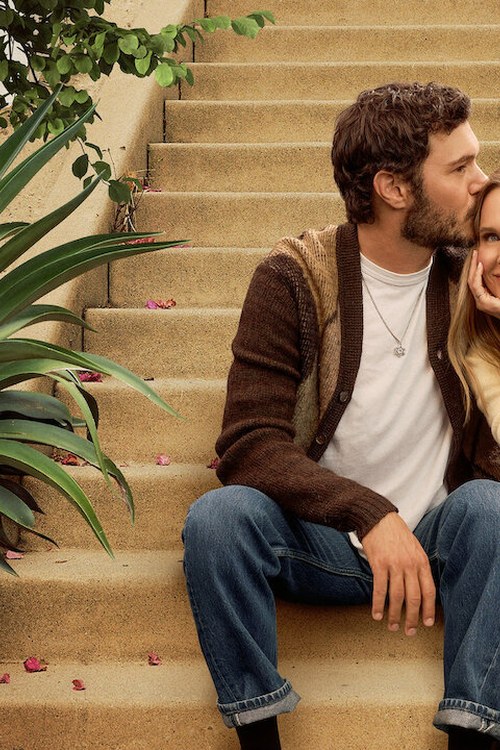
Nobody Wants This · Season 1 · Episode 3 · 26 September 2024
S1E3 Either Aura
A fast, funny pressure test where one great kiss collides with family duty, bad jokes, and a dog-shaped apology.
Noah wants to move on from Rebecca and freely date Joanne, yet avoids confronting his family's anger and defends his actions weakly. The episode turns on that contradiction.
Full episode analysis below. Spoiler-light verdict above.
Updated
Morgan says she has had the greatest kiss of her life, and the episode immediately refuses to let that glow sit still. The thrill is there, giddy and smug, but the hour keeps moving until romance has to survive a hospital visit, a family interrogation, one terrible joke, and a man arriving late with a dog. Attraction is easy when it is a secret game. It gets interesting when everyone else starts billing you for it.
A Kiss With Consequences
The opening stretch understands the specific high of a new romantic possibility. Morgan frames the kiss as an event, then folds it into the game of pretending she and Noah are only friends. The comedy comes from the performance. The relationship has no public shape yet, so every interaction carries a little spy-movie charge without anyone needing to say spy-movie things.
BollyAI's read: this is where the episode is sharpest. The kiss becomes paperwork. Now there are texts to answer, old relationships to face, family members to dodge, and explanations to invent. Romance gets funnier once the show drags it under fluorescent light.
The pivot arrives fast. Noah learns Rebecca has broken her wrist in a bus accident, and the episode yanks him away from flirtation into obligation. That tonal swerve works. Rebecca never becomes a villain or a simple obstacle. Her injury forces Noah to occupy the mess he would rather glide past. He wants Joanne, but the old life still has hospital rooms, worried relatives, and people ready to call his choices stupid.
The pace helps. Dialogue overlaps, scenes clip forward, and the episode refuses to sit in one feeling long enough to turn syrupy. The drawback is that Rebecca’s accident risks playing more like a lever than an injury. The broken wrist matters because it pulls Noah back into his family’s orbit, but the hour gives more energy to everyone’s reaction than to Rebecca’s recovery. That choice keeps the comedy moving. It also narrows Rebecca at the exact moment the story could make her more complicated.
The Family Smells Weakness
Sasha’s question about whether Noah was out with the tiny blonde girl lands like family surveillance disguised as casual banter. He is Noah’s brother and the first alarm bell in a system that already has an opinion. Sasha’s conflicted role matters because he can see Noah’s new interest, but he also belongs to the family machine that prefers the Rebecca version of Noah.
That pressure gets sharper when Esther confronts him at the hospital. She approaches the situation like a prosecutor. Rebecca is framed as the woman Noah was foolish to lose, the "goddess who's always been too good for you," as Esther puts it. The wording is funny because it is excessive, but the emotional logic is blunt. Noah’s family has already cast Rebecca as the correct answer.
This is the hour’s best conflict because Noah is weak in an identifiable way. He wants to move on, but he hates the unpleasant work of disappointing people. He defends himself, though never with much force. The episode avoids punishing him with melodrama. It exposes the cowardice of half-committing. Noah can be charming with Joanne, dutiful at the hospital, and evasive with his family in the same run of scenes. Those versions cannot keep coexisting.
The writing earns its discomfort by making the family pressure specific. Esther’s anger has roots. Sasha’s curiosity has consequences. Together they create a social weather system Noah keeps pretending he can walk through without getting wet. The episode also understands that family pressure rarely announces itself as control. It arrives as concern, jokes, history, and the old confidence of people who think they know who you are supposed to love.
That makes Noah’s hesitation more frustrating and more believable. He is not trapped. He is avoiding a bill that has already come due.
Joanne Meets the Void Where Her Aura Should Be
The Dr. Jay scene is a small comic mirror held up to Joanne’s larger insecurity. He has a hard time finding her aura, and the joke works because it externalizes what Joanne already fears: that something is missing, something morally or spiritually off, something that makes her unfit for a good man. The scene is silly on the surface, but it plugs directly into the character beat.
Joanne wants reassurance that she is a good person worthy of someone good. Instead, she starts spiraling. Her inappropriate jokes are defense mechanisms with bad timing. The pregnancy joke is the big one, because it turns panic into a punchline and then turns the punchline back into panic. When Noah goes silent after it, the episode lets the joke curdle.
That is clever writing, and the performers know how to make embarrassment linger without killing the pace. Joanne’s face keeps doing half the scene after her mouth gets her in trouble. She can see the damage forming, but the joke has already left her. That delay matters. It makes the moment feel less like a sitcom misunderstanding and more like a familiar social disaster: saying the wrong thing because silence would reveal too much.
The speed cuts two ways. The rapid banter keeps the episode buoyant, especially as the hour moves from romantic high to hospital pressure to Joanne’s self-doubt without stopping for a therapy speech. At the same time, Joanne’s spiral could use one more breath. The episode knows her insecurity is real, but it sometimes races toward the next joke so quickly that the hurt has to sprint to keep up.
Still, the character logic holds. Joanne is funny because she is trying to stay in control. She is vulnerable because the jokes are not enough. The episode keeps those facts in contact, and that gives the comedy its bite.
The Dog Is an Apology With Legs
Noah arriving at Joanne’s with a dog after failing to text back is exactly the kind of romantic gesture this episode deserves: sweet, absurd, and guilty. It is a man showing up with a living distraction because he knows silence has done damage and he needs a way back into the room.
The dog works because it gives the scene an object to orbit. Noah can move toward apology without announcing every emotion. Joanne can soften without forgiving him in a clean, polished monologue. The animal becomes a pressure valve, easing the scene without letting Noah off too easily.
There is relief in the payoff to the pregnancy joke too, when "Congratulations. That's amazing" turns misunderstanding into recognition. The line lands because it proves Noah has caught up to the joke and, more importantly, to the woman behind it. He hears what she meant after missing it the first time. That matters more than the gag.
BollyAI's read: the scene is tender because it stays a little ridiculous. That is the show’s lane in this episode. Romance does not need to become noble. It needs to survive bad timing, family judgment, self-sabotage, and an apology prop that may or may not become a household member.
The open loop is useful. If the dog stays, it can become more than a gag. If it disappears, the scene still has a function. Noah chooses to show up. Late, messy, present.
The Verdict
"Episode 3" is a nimble, funny pressure test for Noah and Joanne’s new connection. Its best move is turning the aftermath of a great kiss into a chain of obligations: hospital duty, family judgment, insecurity, silence, and repair. The hour’s weakness is its hurry. Rebecca’s injury and Joanne’s self-doubt each deserve a little more room than the pace allows. Still, the episode’s comic rhythm is confident, and the dog scene gives the final stretch a warm, specific shape.
As a third episode, it plants the season’s central romantic problem clearly. Noah can pursue Joanne only if he stops treating his family’s disappointment like background noise. BollyAI’s score: 7.7/10.