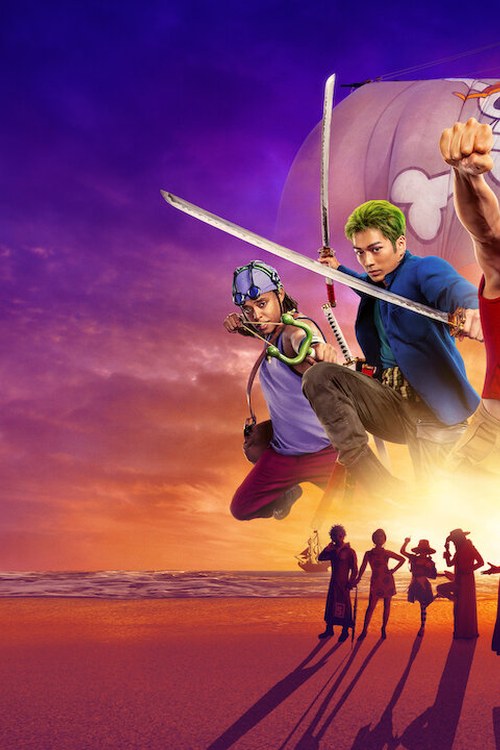
One Piece (Live-Action) · Season 1 · Episode 7 · 31 August 2023
S1E7 The Girl with the Sawfish Tattoo
S01E07 keeps One Piece funny while turning choices into consequences, and it is the crew’s moral pivot that lands.
Rain slicks the deck and the city’s lights look like they are drowning in their own reflection. **Luffy** keeps moving anyway, because stopping is not a behavior he’s ever learned. **Nami** tries to do the practical math in her head, and **Usopp** tries to turn fear into a perfor
Full episode analysis below. Spoiler-light verdict above.
Updated
COLD-OPEN
Rain slicks the deck and the city’s lights look like they are drowning in their own reflection. Luffy keeps moving anyway, because stopping is not a behavior he’s ever learned. Nami tries to do the practical math in her head, and Usopp tries to turn fear into a performance. Then the hour tightens the screws: danger stops being a threat outside the group and becomes a choice the group has to live with. BollyAI's read: this episode is where the story stops being “getting the crew together” and starts being “paying for who they are.”
Spoiler-careful note
This review covers major plot turns in broad strokes. Specific outcomes from later beats are handled with caution where they could spoil beyond S1E7.
-
The Betrayal Game Finally Has Teeth
S01E07 feels like the show testing a promise it made earlier: that this crew is not just a fun bundle of oddballs. Luffy has already defined himself as momentum without permission, and the episode treats that as power and liability at the same time. The key shift is that the stakes stop being about whether they can reach the next location. They are now about whether the choices they make under pressure will cost someone. That is where the “not a betrayal” tightrope becomes visible.
BollyAI’s read: the episode plays like a switch from comedy-driven navigation to character-driven consequences. Nami is forced into a position where practicality is not enough. Usopp is asked to put his mouth where his myths are, and the hour makes that humiliating in a way that still fits his brand. Even Sanji and Zoro (present as forces with different rules about violence and loyalty) work less like “later payoff characters” and more like tools the episode can misuse. The show’s confidence is in its rhythm. It keeps the banter moving long enough that the discomfort lands harder when the hour stops letting everyone have fun.
The episode also sharpens the show’s central craft contradiction. One Piece is supposed to be big-hearted. This hour makes big-hearted mean “you can’t hide from the harm your optimism causes.” That’s the teeth.
-
Pacing as a Weapon: Fast Setup, Slow Burn Consequence
The best part of S01E07 is that it understands the live-action pacing tax. Anime can linger on a look, a beat, a smirk, and it still feels like motion. Live-action has to earn that same emotional pause with blocking, silence, and performance. BollyAI’s read: this episode uses the opposite strategy. It compresses the setup of its immediate problem and then stretches the consequence long enough that the viewer feels the delay as stress.
The hour’s structure is basically: throw the crew into an escalation, let each character try their default coping mechanism, then remove the safety rails. Luffy tries to brute-force the outcome through belief and action. Nami tries to manage risk through calculation. Usopp tries to negotiate with panic by turning it into a story. The episode doesn’t punish these instincts out of spite. It punishes them because it’s time for the story to say: instincts are not immunity.
There’s also a craft benefit in how the show handles exposition. It doesn’t do a “stand still and explain” scene. It does information embedded in movement, in threats, in misunderstandings that become plausible rather than convenient. That keeps the episode from feeling like a checklist. It feels like a pressure chamber.
If there’s a criticism, it’s this: the episode’s tension sometimes relies on a familiar “closed situation, urgent behavior” pattern. When the hour leans too hard on urgency as momentum, it can briefly smooth over how long certain characters would reasonably hesitate. Still, the performances carry the gap, and the writing knows exactly when to let the emotional burn show.
-
Who the Hour Really Belongs To: Nami’s Choices, Not Luffy’s Luck
In S1 earlier episodes, Luffy often acts like the show’s answer key. He runs forward, so the plot follows his feet. S01E07 shifts that balance. The episode still starts from Luffy’s irrepressible motion, but it increasingly makes the emotional question about everyone else’s capacity to keep up with what he drags into the room.
This is especially true for Nami. Her arc in the show is about control: control of the story, control of the crew, control of consequences. In this hour, her competence is not treated as a shield. It’s treated as a lever. BollyAI’s read: the episode’s best dramatic work happens when Nami’s “I can handle this” language (internal or external) collides with the fact that handling is not the same as preventing harm.
Usopp also gets a sharper focus here. His comedy is not just a tone; it’s a defense system. When that defense fails, the episode gives it a cost. The show’s family-adventure tone matters, but so does the bruising. It’s the rare episode where Usopp’s fear lands like something real and not just a punchline waiting to happen.
Meanwhile, Zoro and Sanji function as reminders that this crew’s loyalty is not theoretical. It’s physical. When violence is implied, it’s not abstract. It’s about whether the group will stand together or fracture when the lights go out.
-
Tender, Then Merciless: Comedy Finds a New Job
One Piece’s live-action challenge is keeping its humor from turning into fluff. S01E07 does something smart with the comedic texture. It doesn’t remove humor. It repurposes it. BollyAI’s read: the episode uses jokes as the crew’s way of surviving, then forces those jokes to share space with consequences.
That means the laughs are less about “look how silly these people are” and more about “look how human they are while they’re terrified.” The episode lets Luffy keep being Luffy even when it is no longer safe. It lets Nami keep being sharp even when her sharpness can’t fix the moral problem. It lets Usopp keep talking even when talking is a coping mechanism that buys him seconds rather than safety.
The merciless part comes from how quickly the episode denies the fantasy that bravery will be rewarded automatically. This is not a cruel episode, but it is not a comfort episode. It’s a transformation episode disguised as an escalation episode. That tone management is the show’s real strength.
-
The Crew Moves From “We Want It” to “We Owe It”
By the end of S01E07, the story has nudged the crew into a more uncomfortable truth: wanting something is easy. Paying for it is harder. BollyAI’s read: the episode’s central argument is that the crew’s identity is not just in their goals. It’s in the price they accept when those goals collide with other people’s lives.
That’s why the hour matters for the season arc. Season 1 builds a credibility bridge: it proves it can carry One Piece’s emotional logic in live-action without flattening the comedy or sterilizing the danger. S01E07 is where that credibility stops being an aesthetic achievement and becomes a narrative responsibility. The show starts treating consequences like a character, not a system.
And that is the craft pay-off of the episode. It’s not merely escalating plot. It’s raising the moral temperature of the group. By the finale of the season, that temperature is going to matter.
-
The Verdict
S01E07 is a well-constructed pivot from crew assembly energy to crew consequence energy. The writing keeps the comedy alive, but it stops letting humor act like a substitute for stakes. The pacing is aggressive up front and then sticky in the fallout, which is exactly what live-action needs when emotions must replace animation’s lingering space. Nami and Usopp get the clearest emotional tasks, while Luffy remains the engine whose speed forces everyone else to reckon with cost.
BollyAI’s score would land in the “very good but not flawless” zone if per-episode scoring were available, because the tension sometimes leans on familiar urgency mechanics. Still, the hour earns its place by making the crew’s identity a moral question, not just a personality set.