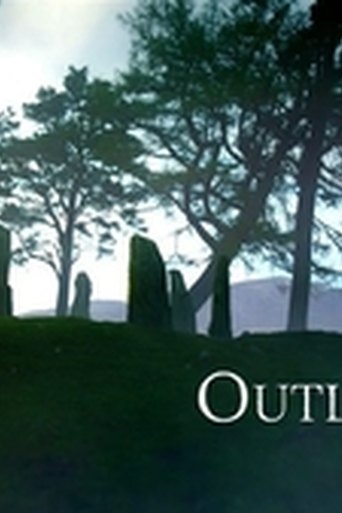
Outlander · Season 1 · Episode 1 · 9 August 2014
S1E1 Sassenach
A sturdy, sharp pilot that turns Claire's rational control into the first casualty of an impossible journey.
THE MOMENT Claire's first full view of Castle Leoch - the moment the show commits to its 18th-century world without apology.
The premiere establishes both timelines - 1945 Scotland and 1743 Scotland - with clarity and visual confidence. Claire's displacement through the standing stones at Craigh na Dun is handled as unsettling fact rather than fantasy spectacle, which sets the tone for everything that follows.
Full episode analysis below. Spoiler-light verdict above.
Updated
A man cries out to be held. A doctor and nurse respond, and the hour opens with emergency before romance, scenery, or mystery. That choice matters. Claire enters as someone trained by crisis, not fantasy. War has taught her that panic is useless and that the body gives evidence. Then Scotland gives her evidence that refuses to behave. "Sassenach" works because it does not ask Claire to accept wonder. It makes her fight wonder with reason until reason loses the case.
The War Does Not End Cleanly
The V-E Day memory is the premiere's smartest anchor. Claire recalls the end of war and the possibility of a longed-for life, but the episode does not treat peace as a reset. The emergency opening leaves the body in the room before the voiceover sorts the feeling. That order gives Claire a clear shape: she wants a life after war, yet her instincts still belong to a battlefield.
That is why the Scottish trip matters beyond scenery. The second honeymoon frames the journey as repair. Frank is part of that effort. Their early scenes have the rhythm of two people trying to rebuild ordinary life through curiosity, conversation, and history. Even the blood-marked doors become a puzzle they can discuss. Frank identifies the black cockerel sacrifice, and the hour lets that explanation sit between folklore and method.
The craft is clean. The first movement stays talky, reflective, and measured, with enough silence around key moments to suggest the quiet is waiting to break. The premiere does not rush its impossible premise. It builds Claire as someone who believes the world can be examined, named, and survived. That makes the rupture sharper. If she were a dreamer, the time displacement would be easy. Because she is practical, it becomes an argument.
Omens With Names Attached
The tea-leaf reading could have been soft nonsense in a weaker pilot. Here, it has useful specificity. The leaves and palm reading give shape to unease without explaining it away. Nearby, the Duke of Sandringham is named through Frank's historical research as Jonathan Randall's protective patron, and the proper noun does real work. Protection, influence, rank, patronage: the episode plants a world where power travels through names before Claire understands the world she has entered.
The same goes for Frank's report of the vanished Highlander outside Claire's window. The beat is small, but it tightens the hour's logic. A ghostly encounter would be too easy as pure spectacle. Instead, it arrives through Frank's attempt to manage and understand what happened. His worry keeps him active in the mystery, even as the story's pull moves toward Claire.
That is the premiere's first strong reversal. The rational husband, the historical explanation, the ritual detail, the named patron, and the possible apparition all belong to one chain. The episode keeps offering explanations that feel almost sufficient. Almost is the trap. Every fact makes the world look more legible until Claire crosses into a version of history where legibility becomes dangerous.
The hour slips when some of this machinery announces itself too bluntly. The tea leaves, vanished figure, blood ritual, and second honeymoon framing sit close together. The premiere sometimes stacks signposts like a show worried viewers might miss the road. Claire is the saving grace. Her skepticism keeps the material from floating away.
The Wrong Man Wears Frank's Face
The confrontation with the man claiming to be Jonathan Randall is the hour's hard pivot. It takes the most intimate form of recognition, a familiar face, and turns it against Claire. She is confronted by Jonathan Randall, not Frank. That distinction is the scene's engine. Claire is displaced in time, then displaced inside her own trust.
This is where the premiere's patience pays off. Frank has been presented as someone who investigates, asks, identifies, and worries. Randall arrives as the nightmare version of that face: authority without safety, pursuit without comfort. The episode does not need a lecture on the brutality of the new world in this moment. The mismatch does the work. Same face, wrong man, wrong century.
Claire's central contradiction snaps into focus. She wants to act as if she is grounded in the present and can explain what is happening. Then she reports an impossible time displacement and recognizes that the old rules are gone. The key line lands as a defeat for ordinary logic: Claire knows in her heart she is no longer in the 20th century. Used too early, that realization would flatten the mystery. Placed after confrontation and flight, it feels earned.
The tonal shift is sharp. The early reflective mode gives way to urgency. Claire struggles to escape and tries to find the road back to Inverness. The road is a practical goal, which is why the sequence works. She is not trying to solve the metaphysics of time travel. She is trying to locate a route, a town, a way back. The premise is enormous. Claire's objective stays human-sized.
Survival Is Claire's First Language
After the displacement, the episode does not turn Claire into a passenger. That is the key to "Sassenach." She wants to escape, survive, fix what can be fixed, and keep moving despite injuries and threats. The character beat is consistent with the opening emergency. Her medical competence and crisis discipline are not decorative backstory. They become the grammar of her survival.
The arrival of Jamie gives the back end of the hour a different momentum. He needs treatment, accepts help, and urges continuation. That exchange matters because it creates a practical bond before anything grander can form. Claire helps because she can. Jamie continues because he must. The episode is at its best when need drives connection.
The premiere understands that action is clearest when built from tasks. Escape. Find the road. Treat the injured man. Keep moving. Ask whether pursuit is coming. These are simple beats, but they give the fantasy premise muscle. The danger is not abstract. It arrives through patrols, confusion, pain, and the possibility that Randall or men like him can close the distance.
The action-heavy final stretch carries a cost. The shift from reflective Scotland to immediate threat is exciting, but the hour compresses a lot of orientation into a short span. Claire's disorientation is the point, yet the storytelling risks making the viewer share too much of that scramble. More spatial clarity around the escape and road search would have sharpened the suspense. Still, the emotional line holds. Claire keeps acting because stopping would mean surrendering to the impossible.
A Beginning That Refuses Comfort
The final beat, Claire concluding that her journey has only just begun, could have played like a generic pilot button. It lands better because the hour has defined journey as something brutal and bodily. This is not a postcard into the past. It is a passage from war trauma into another kind of danger, with Claire's desire for choice placed under immediate pressure.
The title, "Sassenach," carries that outsider energy without requiring heavy explanation. Claire is outside her time, outside her explanations, and outside the social codes forming around her. The premiere's argument is simple and effective: Claire's strength is rational control, and the story's first job is to break the world around that control without breaking her.
For a first hour, it is sturdy, atmospheric, and more disciplined than its pile of omens suggests. The best material belongs to Claire under pressure: the emergency framing, the Randall confrontation, the escape toward Inverness, and the practical bond with Jamie. The weaker material sits in the crowded foreshadowing. The episode plants many doors, then chooses the right one to slam shut first.
The Verdict
"Sassenach" is a strong pilot because it treats time travel as a crisis of evidence before adventure. Claire's war-shaped practicality gives the hour its spine, and the episode keeps testing it with ritual, apparition, mistaken identity, injury, and pursuit. The opening half over-signals some mysteries, but the back half finds a cleaner pulse once Claire is displaced and forced to act. BollyAI's score: 8.0 out of 10. As a season opener, it does the necessary work: it builds the marriage and the mystery, then leaves Claire in a past where survival has replaced explanation.