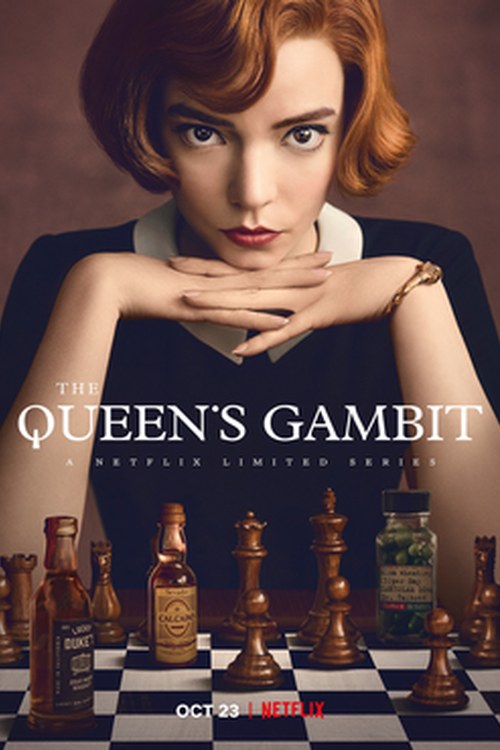
The Queen's Gambit · Season 1 · Episode 1 · 23 October 2020
S1E1 Openings
A sharp first move that turns chess into Elizabeth’s private rebellion against rules, loss, and managed childhood.
THE MOMENT Beth's first encounter with the chess board in the basement - a child's face registering that she has found the one language she speaks fluently.
The premiere establishes Beth Harmon in the orphanage basement, a nine-year-old watching the janitor play chess on a concrete floor. The show earns immediate trust by refusing to sentimentalise her circumstances - the addiction thread is seeded in the first ten minutes via the institution's tranquiliser regimen. It is a confident, unhurried setup.
Full episode analysis below. Spoiler-light verdict above.
Updated
A child arrives after a collision on New Circle Road, and the first language around her is not comfort. It is procedure, diagnosis, placement. Someone calls it "a goddamn miracle." The episode lets that line hang without softening it, because Elizabeth Harmon is treated less like a miracle than a problem to file correctly. That is the spine of "Openings": talent appears inside a system built for obedience, and the hour keeps asking which one will bend first. The episode works because it makes chess feel less like escape than a private language Elizabeth has to smuggle past adults.
A Miracle With Paperwork
"Openings" begins with displacement before identity. Elizabeth is introduced through aftermath: orphaned by the collision, delivered into an institution, surrounded by adults who speak in fragments of shock and management. A caretaker's "Thank you" lands with the chill of routine. The episode is not sentimental about arrival. It understands that, for a child, being processed can feel like being erased.
That is why the profanity near the start matters. "You're all a bunch of fucking cocksuckers!" is ugly, abrupt, and useful. It punctures the polite surface of the place immediately. The institution has rules, but it also has noise, resentment, children learning how to survive through defiance or performance. Elizabeth enters a world where order is advertised, while control runs the room.
The smartest move here is restraint. The episode does not rush to explain Elizabeth through speeches. It lets short exchanges do the work. Names arrive plainly: "Beth." "Jolene." Identity is reduced to what can be said quickly in a new room. Jolene immediately registers as someone who knows the system's rhythms, especially around pills or vitamins. Elizabeth watches, absorbs, and studies the place before she can speak its habits.
The first act makes its argument without underlining it. Elizabeth has survived something extraordinary, but survival does not give her agency. It gives her a bed, rules, and adults deciding what shape her life should take next.
Alice Refuses the Official Story
The episode's most revealing early contradiction belongs to Alice Harmon. She wants Elizabeth with her, and she rejects the idea that the institution is where Elizabeth belongs. Her claim that Elizabeth belongs in a trailer in the middle of nowhere is rough, defensive, and loaded with private history the hour does not fully unpack. Then she concedes: "You win."
That concession is the wound underneath the episode. It plays less like a clean legal decision than a defeat. Alice disputes ownership with the blunt question, "Who says she's ours?" The phrasing matters because the whole episode is obsessed with who gets to claim Elizabeth. Family claims her, then loses. The institution claims her through placement. Chess will later claim her through recognition. Elizabeth's claim on herself is still forming.
This is where "Openings" earns its title beyond the chess pun. The hour is full of first moves, and most of them are made by other people. Adults decide where Elizabeth goes. Staff decide what she may do. Jolene teaches her how to function inside the regimen. Even cleanup duty, sending erasers down to the basement, becomes a route chosen for her before she can turn it into opportunity.
The Alice material gives the episode a necessary bruise. Without it, Elizabeth's institutional life could play as tidy origin-story machinery. With it, the hour carries a sharper question: is Elizabeth being rescued, managed, or transferred from one instability to another?
The Basement Becomes a Board
The basement chess thread is the episode's cleanest craft engine. Elizabeth is ordered to take erasers down, a practical chore with no romance in it. The show turns that errand into discovery. That is strong origin-story writing. The extraordinary does not arrive with trumpets. It sits below the main floor, half-hidden inside routine.
The chess lessons shift the episode's rhythm. The early scenes move in short, interrupted exchanges, full of institutional friction and sudden profanity. Once chess enters, the hour slows into rules, sequence, and attention. That pace change is not dead air. It teaches the viewer how Elizabeth's mind finds shape. She wants to play, but more than that, she wants to be allowed into the logic of the game.
The key beat is the rule shift in-scene: "Then, how come I couldn't go first before?" Elizabeth asks. That question is technical on the surface and emotional underneath. She is not asking for praise. She is interrogating fairness. The game gives her a way to challenge authority without sounding like rebellion. It gives her a grammar for power.
The basement also sharpens the central contradiction. Elizabeth wants to continue chess through irregular access, in a place she has found for herself. When confronted, she confirms she has gone there. The institution's promise of safety is exposed by something as small as a route downstairs. The system can regulate bodies, pills, chores, and schedules. It cannot quite regulate curiosity once Elizabeth has found a board.
Rules Have Better Posture Than Compassion
Helen Deardorff is not written as a cartoon obstacle, which helps the episode. She wants rules and proper placement enforced. When she challenges Elizabeth's basement chess, the line "This is very irregular, Elizabeth" says almost everything about her function. The problem is not simply chess. The problem is unsanctioned space, mentorship, and desire.
That is the hour's best tension: the institution can feed Elizabeth and still fail to see what feeds her. It can keep her inside and still misunderstand what is happening inside her. Deardorff's concern is legible. A child disappearing to the basement is an administrative problem. But the episode is on Elizabeth's side because it has already shown chess becoming the first arena where she is no longer only acted upon.
Jolene's role deepens that world. Her focus on pills or vitamins, her teasing insistence that Elizabeth follow the rules, makes her more than a sidekick. She is a survival manual in human form. She understands that control inside the regimen comes from knowing when to comply, when to mock, and when to keep moving. Elizabeth is learning a different kind of control through chess, but Jolene's version gives the episode texture.
The weakness here is that the authority beats can feel blunt. The institution's resistance to chess is clear, maybe too clear. Still, the bluntness has a purpose. "Openings" wants the viewer to feel how little room Elizabeth has before the chessboard appears. The more rigid the walls, the more electric the basement becomes.
The Offer Is Recognition, With Conditions
The high-school chess club opportunity gives the episode its forward snap. A contact asks for a game, and later Elizabeth is offered the chance to "perform for the chess club." That word, perform, carries weight. It promises recognition, but it also turns Elizabeth's gift into something to be displayed under terms set by others.
This is where the episode's craft gets sharp. Elizabeth wants to play chess and be recognized as gifted. The offer answers that desire, but not cleanly. She gets a door, yes, but the door comes with adult supervision, institutional approval, and the possibility that her talent will be treated as demonstration before it is treated as selfhood. The hour understands that recognition can become another form of management.
The final quiet exchange, "Mama?" and "Elizabeth," pulls the episode back from chess as fantasy. The board gives Elizabeth order, but the child's need for attachment has not disappeared. That ending prevents the chess plot from becoming a neat upgrade from trauma. Elizabeth is not healed because she can calculate. She is newly armed.
Season-wise, "Openings" does what a first episode should do: it plants Elizabeth between rule and instinct, then gives her one move that might change her future. It does not cash in too early. It teaches the game, the wound, and the cage.
The Verdict
"Openings" is a strong first move because it treats chess as character pressure, not decoration. The episode's best writing comes from the contrast between institutional routine and Elizabeth's private intensity: chores become access, rules become friction, and a basement board becomes the first place she can test power without asking permission. The hour is a little blunt when authority steps in, and some early institutional beats are more functional than rich. But the structure holds. Elizabeth's gift is introduced through behavior, not applause, and the chess club offer gives the season a clean engine without solving the loneliness underneath. BollyAI's score: 8.4/10.