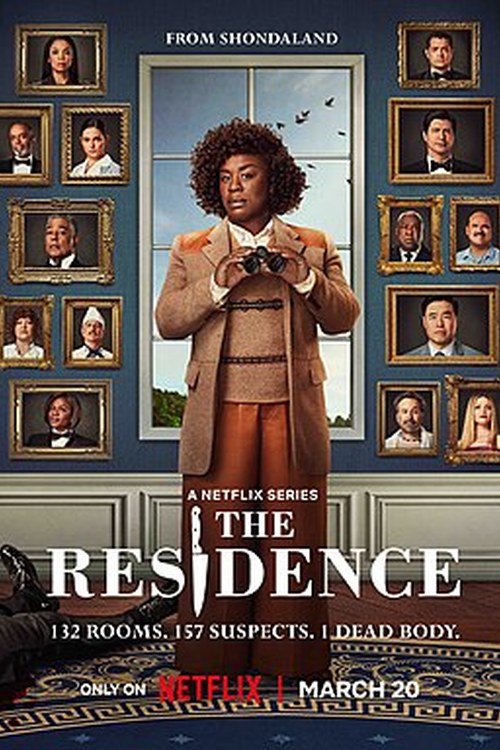
The Residence · Season 1 · Episode 1 · 20 March 2025
S1E1 Pilot
A sharp procedural opener where titles, locked rooms, and one impossible shirt make bureaucracy look guilty.
THE MOMENT Cordelia's first methodical survey of the murder scene, listing observations in a sequence that is funny and frightening in equal measure.
The premiere drops Cordelia Cupp into the White House residence with a dead body and 157 potential suspects. The episode functions primarily as a showcase for Aduba's physical and verbal performance style: odd, precise, warm beneath the social abrasion. The White House setting is well-used as a closed-room mystery location with genuine architectural interest.
Full episode analysis below. Spoiler-light verdict above.
Updated
Jasmine Haney is asked to state her name for the record. She does. The hour begins with procedure, the kind of official language that makes chaos look manageable because someone has written it down. Then Agent Rausch arrives with an incident, Kylie Minogue is apparently in the Lincoln Bedroom, and the White House becomes less a seat of power than a locked box with too many people holding keys.
BollyAI's read: "Pilot" works best when it treats bureaucracy as the crime scene. The death matters, but the episode's sharper idea is that every title, hallway order, and official assumption might be part of the mess.
A Name for the Record, a House Full of Secrets
The first useful move is plain. Jasmine states her name. The line is procedural, almost dry, but it places her inside a system before the mystery fully announces itself. The episode understands that the White House is never just a location. It is a machine of rooms, staff roles, access, restriction, and public-facing control. When someone says, "I'm the Chief Usher of the White House," the title does half the dramatic work before the plot catches up.
That is the pilot's best instinct. It does not make the death loud at the start. It makes authority specific. Jasmine has a role to perform, and her immediate concern includes the absurd glamour of Kylie Minogue staying in the Lincoln Bedroom. That detail does real work. Even crisis here must compete with guest management, optics, and the strange theatre of important people sleeping in historic rooms.
Then Rausch cuts across that rhythm. "An incident. I don't want anyone up here for the rest of the night, okay?" The wording is bland. The order is not. Keep people away. Restrict movement. Control access. The mystery starts before the body is fully argued over, because the first suspicious act is containment.
Cordelia Cupp Refuses the Easy Shape
Cordelia Cupp enters as the necessary irritant. By the time she is questioning a new arrival and Lawrence Dokes is introduced by name, the hour has built the room around competing instincts. One side wants a workable explanation. Cupp wants the explanation to survive contact with evidence.
That tension lands in the sealed-window discussion. The windows are described as sealed or locked from the other side, and the working belief moves toward suicide. The line "That is what it appears to be" is exactly the kind of sentence this episode distrusts. It sounds careful. It also sounds like a door being closed.
Cupp's function is to keep that door open. She inspects, argues, and resists the comfort of the obvious. The episode's craft here is less about surprise than friction. People keep trying to put the death into an administratively useful category. Cupp keeps treating the category as another clue.
The pilot is clever about how quickly "suicide" becomes convenient. Once that label is available, it can calm the room, justify pace, and shrink the list of obligations. Cupp's pushback gives the episode its spine. She is solving a death while fighting the institution's appetite for a clean answer.
The Clock Starts Talking Over the Clues
The mid-episode debate over tactics and time is where "Pilot" gets denser, sometimes to its benefit and sometimes against itself. The dialogue accelerates after the incident orders and restriction, then packs itself tighter during the evidence argument. That escalation fits the story. A locked-down White House should feel like a pressure cooker with a legal pad.
Edwin Park brings another kind of tension. He wants the FBI involvement and investigative context to matter, and his irritation around the presence of a consultation detective gives the hour a useful professional squabble. The case concerns what happened to A.B. Wynter, but it also concerns who gets to define what happened, and whose process counts.
That is a smart pilot problem. Multiple officials in a room can turn into noise if the writing lets every character become a job title with dialogue. Here, the episode mostly avoids that by attaching each procedural argument to turf. Cupp wants the death treated as a crime scene. Park wants his lane respected. Dokes is introduced inside that official ecosystem. Jasmine is pulled from management into investigation orbit.
The weakness sits here too. The density occasionally bunches up. Because the episode withholds so much and leans hard on positional conflict, some exchanges feel like machinery being displayed instead of character being revealed. The pilot is sharpest when a fact changes the room. It sags when the room argues its own importance.
The Suicide Theory Gets a Public Enemy
The late confrontation gives the episode its cleanest dramatic voltage. Someone asserts that "A.B. Wynter was killed" and that the investigation was shut down. That is no small disagreement over interpretation. It is an accusation about narrative control.
The Senator's contradiction matters because it turns the procedural question into a political one. The stated desire is to get facts out for the public without indulging politically motivated conspiracy theories. Then the stance shifts toward claiming shutdown and murder against the suicide frame. The episode uses that contradiction well. It does not need to settle the Senator's motives yet. It only needs to show that truth, in this house, is already being handled like a weapon.
This is where the pilot's structure pays off. Earlier, the suicide theory sounded like an investigative position. By the confrontation, it also sounds like a possible convenience. Earlier, restriction sounded like security. Later, it can read as obstruction. The facts have not changed. The frame around them has.
The hour plants open loops without over-explaining them: whether Wynter died by suicide or murder, where A.B. sits in the timeline and the Chief Usher question, and why Cupp ends the episode connected to Wynter through a shirt. Those are efficient hooks. They come from objects, titles, and sequence, not from someone announcing that the mystery is complicated.
A Shirt Is the Best Cliffhanger in the Room
The final turn is material. "Lock it down. Now." Then Cupp discovers she is wearing A.B. Wynter's shirt.
That image works because it is intimate in a story full of official distance. A sealed window is a puzzle. A title is a power structure. A shirt is contact. It implies access, timing, proximity, and a sequence that the episode has not yet earned the right to explain. More importantly, it makes Cupp part of the evidence field without making her suddenly foolish. The object rewrites the scene around her.
It is also a good pilot cliffhanger because it narrows the chaos. The White House, the FBI, the police, the Senator, the Chief Usher question, Kylie Minogue in the Lincoln Bedroom: the hour is juggling plenty. The shirt cuts through that sprawl. One person. One garment. One dead man's name attached to the living detective's body.
The episode ends on something understood instantly and explained later. That is what a mystery opener needs. The audience does not need a lecture about why it matters. The room locks down because the clue has already done the talking.
The Verdict
"Pilot" is a strong opener with a clear argument: in this White House, procedure can hide chaos as easily as clean it up. The episode turns names, rooms, access orders, sealed windows, and one stolen or misplaced shirt into a system of suspicion. Cupp gives the hour a firm investigative spine, while Jasmine's interrupted duties and Park's turf tension keep the mystery from becoming a single-lane whodunit.
The flaw is density. Some mid-episode exchanges stack authority against authority without giving every beat equal dramatic bite. Still, the final confrontation and shirt reveal give the season a sturdy engine. As a first chapter, it plants the right questions and treats official language as part of the crime scene.
"Aduba holds everything together with a deft turn, refusing to let Cordelia Cupp's on-paper oddities ever become a caricature."
Hollywood Reporter