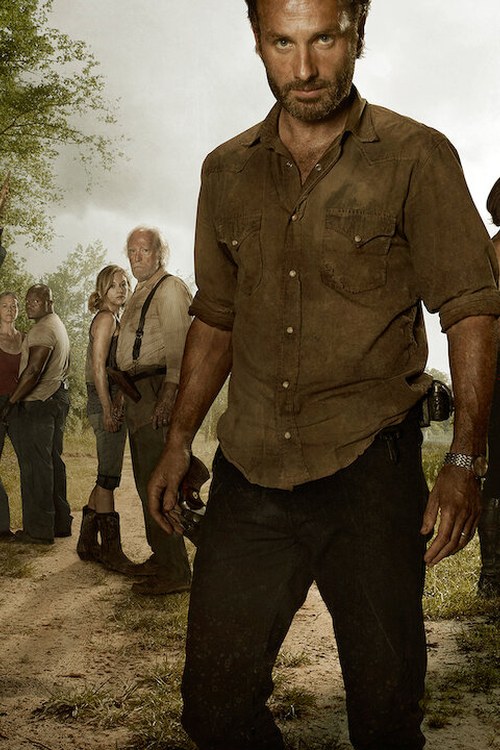
The Walking Dead · Season 1 · Episode 1 · 31 October 2010
S1E1 Days Gone Bye
A packed, bruising Daryl hour where survival skill matters less than whether the group can trust what it sees.
THE MOMENT Rick on horseback entering deserted Atlanta - the scale of the world's end rendered in a single breathtaking shot.
Rick Grimes wakes from a coma to find civilisation gone. Darabont's direction turns empty Atlanta streets into one of television's most striking opening images. The zombie genre gets its prestige TV moment.
Full episode analysis below. Spoiler-light verdict above.
Updated
Daryl comes back covered in blood, and the room reads him wrong. One look turns survival into threat. Andrea fires. The hour’s bluntest idea lives in that cut: in this world, competence can look exactly like danger if it arrives from the wrong angle. Daryl is built as the man most equipped to stay alive after collapse, but the episode keeps proving that survival skill does not translate into trust. This is a dense, jagged character hour about a loner trying to become useful to people who keep deciding his fate for him.
The Loner Is Already Being Rewritten
The hour gives Daryl a clear shape at the start: he can survive when the world falls apart. He moves through blood, panic, and bad terrain better than most. Then the episode undercuts that advantage by making every social space harder for him than any walker herd.
The tension is plain. Daryl wants to do the right thing for his people, and he refuses to leave someone behind when others are ready to move on. That instinct should make him valuable. Instead, it puts him at odds with the group’s immediate choices. His brother Merle is described as a danger, handcuffed on a roof and still there. That single fact does heavy work. It makes Daryl’s loyalty inconvenient before he can act on it.
That is where the writing has teeth. Daryl’s survival code is personal. The group’s survival code is practical. The clash does not need a speech. A brother left behind on a roof is enough.
The compression is rougher. The hour sketches Daryl as loner, brother, threat, protector, and future second-in-command in a rush of pivots. The spine is strong, but the episode sometimes sprints past the bruise.
Blood Makes the Wrong First Impression
The Andrea shooting is the episode’s sharpest visual turn. Daryl returns covered in blood, and the mistake happens fast. He looks like one of the dead. Andrea shoots him.
That beat works because it makes the world’s rules cruelly practical. Nobody gets time to ask who someone is if the body in front of them reads as danger. Daryl’s ability to survive outside the group becomes the exact thing that makes him unsafe inside it. The episode turns his competence into bad evidence.
It also isolates him without stopping the plot. He is present, active, and useful, yet still misread. The hour does not have to announce that he is alienated. It makes him bleed for it.
The event lands among other rapid escalations, including Sophia running off during the group’s first walker herd and the larger scramble of searches and attacks. The density gives the episode momentum, but it steals some aftermath. Andrea shooting Daryl deserves more room to curdle. The hour moves on because it has to. Efficient television, at a cost.
A Second Who Still Gets Sidelined
Daryl becoming Rick’s second is the hour’s most interesting status shift. It suggests trust, hierarchy, and usefulness. It also sets up the contradiction that defines him here: he keeps being given responsibility, then having control taken away.
That pattern is everywhere. He wants to keep searching and do what he thinks will help. Other decisions interrupt him. He wants to protect the people he has found as family. Failure still gets processed as self-blame. He wants peace and movement beyond conflict, but enemies and emergencies pull him back into the fight.
The episode’s strongest craft move is to make Daryl’s promotion feel unstable. Being Rick’s second does not make him safe. It does not guarantee that his choices will carry the day. It only raises the pressure when the group’s needs collide with his private code.
That is good character architecture. A weaker hour would treat the new role as a reward. This one treats it as another trap. Daryl is closer to the group, so he has more to lose. He has more authority, so failure cuts closer. The episode understands that belonging can punish a man already trained to blame himself.
The Baby Arrives, The World Does Not Pause
The prison fight gives the hour one of its hardest tonal turns. Lori says the baby is coming now, and the timing is merciless. The line does not soften the episode. It tightens it.
That is the kind of interruption this story understands best. Bodies do not wait for plans. Birth enters during violence, and the group has to absorb it as another emergency instead of a separate emotional chapter. The beat expands the stakes without grand language. A baby arriving in the middle of a fight is danger, hope, logistics, and panic packed into one human fact.
The episode’s high narrative density helps this moment because the audience has already been trained to expect no clean separation between crisis and consequence. Searches, a herd, injury, role changes, and conflict keep stacking. The baby beat fits that pattern.
The pace remains a double-edged blade. The momentum is impressive. The emotional processing is thinner. Lori’s moment has enough force to stop the room, but the structure keeps shoving forward. The episode gains urgency and loses breath. For a premiere-shaped hour, that may be a fair trade. For a character study, it leaves bruises unexplored.
Capture Is The Real Cliff
Daryl being taken prisoner as the group escapes is the major escalation because it externalizes the episode’s recurring problem. Other people have been deciding around him all hour. Now an enemy force decides for him.
That capture lands because it grows from the same contradiction working underneath every beat. Daryl wants to protect and search. He refuses easy abandonment. He keeps pushing toward the hard, loyal choice. The world answers by removing his agency altogether.
The open loops are clean. What happens after he is taken prisoner? How will his role with the group affect his ability to keep searching and protecting? If Merle returns to the board, will he be treated as an asset or a threat? Those questions give the season a useful engine. They are personal, practical, and ugly in the right way.
The Alpha beat, where Daryl is called a liar after Alpha’s death is announced, widens the frame further. It shows how even victory can become another test of credibility. Daryl can do the dangerous thing and still be doubted when he reports it. That is the episode’s thesis in one harsh pattern: surviving is his gift, being believed is his problem.
The Verdict
"Days Gone Bye" is strongest when it treats Daryl as a man whose usefulness keeps getting mistaken for threat. The blood-covered return, Andrea’s shot, the Merle problem, the promotion under Rick, and the prisoner turn all push the same argument: this character can survive the dead more easily than he can survive group judgment. The hour is less successful when its dense sequence of pivots refuses to sit with the damage it creates. Sophia runs, Lori goes into labor, Daryl is shot, elevated, and captured, and the episode sometimes races like it is afraid of silence. Still, the spine holds. As a season opener, it plants personal loops with enough bite to make Daryl’s future feel earned rather than decorative.
"The show is so much better than recent non-Romero zombie movies it's among the leading exhibits in the case against the cineplex."
The Baffler