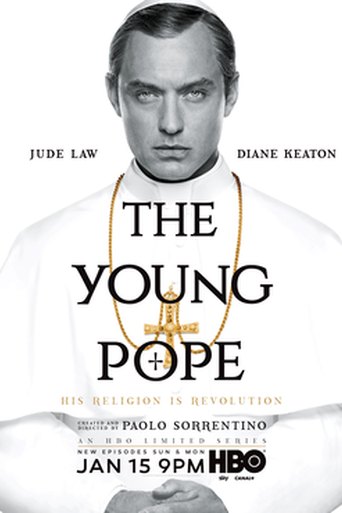
The Young Pope · Season 1 · Episode 1 · 21 October 2016
S1E1 Episode 1
A sharp, talk-heavy premiere where papal authority arrives as a costume Lenny can wear but cannot yet believe.
THE MOMENT Lenny's fantasy address to the crowds - the new Pope's creed delivered in a surrealist reverie that announces the show's ambitions.
The opener establishes Sorrentino's formal vocabulary immediately - a dream sequence in which the new pope crawls over a pile of children, then delivers a hilariously provocative speech. The tone is set: equal parts deadpan comedy and spiritual unease. Jude Law commands every frame.
Full episode analysis below. Spoiler-light verdict above.
Updated
The first claim is simple. A man says he serves God and will forget no one. A few scenes later, that same man has to shout his own office into existence. Lenny Belardo is surrounded by people who treat the papacy as a title to be assigned, managed, corrected, or explained. He answers as if identity can be forced into place by saying it hard enough. The episode’s argument is already there: this is a story about a Pope whose authority gets louder as his belief looks less settled.
A Crown That Has To Be Spoken Aloud
The hour understands the absurd terror of a role before it understands the man inside it. Lenny’s early declaration of service gives the episode a clean religious frame: he belongs to God, he must remember everyone, and the burden sounds total. Then the frame starts wobbling. He is confronted with the denial, “You’re not the Pope,” and his answer is pure force: “I am the Pope!”
That line is the episode’s ignition point. It is not calm authority. It is a man dragging reality toward him by the collar. The beat works because the episode refuses to let the title sit comfortably. Lenny wants papal identity affirmed, yet the hour surrounds him with contradiction. He is Pope-to-be, then denied, then Pope by insistence, then formally reframed as Pope Pius XIII.
The writing’s best move is making the office feel ceremonial and unstable. The title exists. The clothes, names, and protocols can be arranged around him. Yet Lenny’s authority still has to pass through other people’s mouths before it becomes official in the room. Power here is language repeated until nobody dares interrupt.
That makes the first act dense, even prickly. The dialogue is ideological from the start, and the hour occasionally risks turning people into walking definitions. Still, the friction is productive. Lenny is introduced through a dispute over what he is allowed to be.
The Vatican Turns Theology Into Office Politics
The cardinals’ debate over the Holy Spirit gives the episode its sharpest institutional joke and its clearest diagnosis of the Vatican around Lenny. The room begins with divine language and ends with management language. When the discussion lands on the conclusion that the Holy Spirit is another name for Voiello, the episode pulls off a neat blasphemy of bureaucracy: heaven has a chain of command, and somebody in the building thinks he runs it.
That beat reframes Lenny’s ascension as something other than a purely spiritual event. The dossier’s political line about a “telegenic puppet” points in the same direction. The men around the papacy are asking what God wants, but they are also asking who can be used, who can be shaped, and who will sit in front of the machinery without seeing the gears.
The episode is strongest when it lets those languages contaminate each other. Religious vocabulary slides into administrative control. Administrative control borrows the majesty of religious vocabulary. The result is a Vatican where faith is present, but rarely alone in the room.
The criticism lands here too. The early stretch stacks so many declarations about power, holiness, names, and control that some supporting figures arrive as functions before they arrive as people. The Voiello idea has bite. The machinery is clear. The human temperature around that machinery still needs time to rise.
Formality As A Threat
Lenny’s warning that friendly relationships are dangerous is one of the episode’s cleanest windows into his method. He praises formal relationships, and the line immediately gives shape to his papacy. This Pope treats distance as protection, hierarchy, and weapon.
That choice locks into the hour’s repeated name and role negotiations. Domen identifies himself as “One who belongs to God,” and the logic gets bent through belonging until identity becomes a chain. Federico reports on written works about “me,” including “The man behind the scenes.” Those flourishes belong to an episode obsessed with how people are named, placed, and possessed by titles.
The writing keeps asking a blunt question: who owns a person once the institution names him? Lenny claims God. Others claim procedure. Domen’s formulation pushes belonging into theology. Federico’s report turns the Pope into subject matter, something already being written about, framed, packaged, interpreted.
The formality line ties it together. Lenny appears to understand that intimacy would make him negotiable. A friendly Pope can be leaned on. A formal Pope can become unreadable. There is a hard little thrill in watching the hour build that idea through dialogue rather than action. The danger is that the episode can feel airless when every exchange carries symbolic freight. But that airlessness serves the point. This is a world where even warmth needs clearance.
The Confession Breaks The Office Open
The final confession-like exchange with Tommaso is the hour’s best reversal because it takes the role Lenny has fought to secure and drops a crack through it. Tommaso wants to conduct and manage confession, to hold the shape of spiritual authority in place. Lenny uses that same setting to say, “I’m saying that I don’t believe in God, Tommaso.”
It is a brutal line to place after an episode of papal re-identification. Earlier, Lenny needed the world to accept him as Pope. Here, he says the thing that makes the office sound impossible. The episode does not need a thunderclap because the contradiction is already loud. A Pope without belief is the central wound of the hour.
What makes the beat work is the way it turns Tommaso into more than a listener. He becomes the test case for whether the system can process Lenny at all. Is this a joke, a confession, a crisis, a tactic? The episode leaves that loop open, and the uncertainty has value. Lenny’s identity has been constructed through declarations, formal naming, and institutional pressure. In the confession space, the construction meets conscience.
The episode earns its final provocation because it has spent the hour making the papacy a verbal battlefield. The last line does not come from nowhere. It is the hidden answer to every earlier argument. If identity has to be shouted, assigned, and formalized, belief may be the one thing nobody in the room can manufacture.
The Verdict
“Episode 1” is a strong, talk-heavy opening that understands its central contradiction and keeps tightening around it. The hour’s best craft choice is structural: it begins with service to God, moves through disputes over papal identity, lets Vatican politics translate holiness into control, then ends with Lenny’s confession of disbelief. That line gives the episode bite.
The premiere has flaws. The ideological dialogue can crowd out ordinary human texture, and a few supporting figures enter as ideas before they become characters. Still, the episode has a spine. It treats the papacy as office, performance, and pressure chamber. As the season’s first step, it plants the right open loops: whether Lenny is Pope in any meaningful sense, what Voiello’s power means, and whether Tommaso has just heard a joke or a spiritual emergency.
"Sorrentino's approach is bracingly different - over-the-top melodrama with profane comedy helping overcome an occasionally muddled plot."
Rotten Tomatoes Critic Consensus