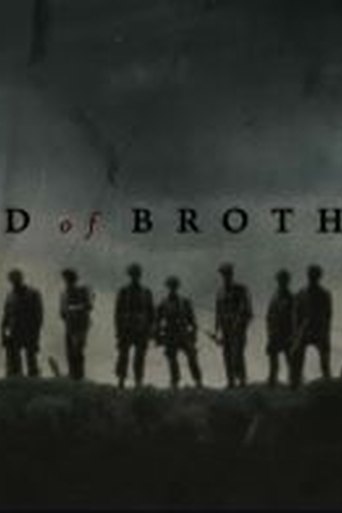
Band of Brothers · Season 1 · Episode 6 · 7 October 2001
S1E6 Bastogne
A spare, punishing Bastogne hour that turns missing supplies into the season's sharpest measure of fear.
The hour narrows in on the same war, then changes the feeling by changing who holds the camera. Easy Company’s mission rhythm turns into something sharper and more intimate, as leadership decisions, squad survival, and the cost of “getting it done” collide. BollyAI’s read: the ep
Full episode analysis below. Spoiler-light verdict above.
Updated
Bastogne begins as subtraction. Food goes first, then winter clothes, then ammunition, then bandages, then certainty. The men do not enter the woods like an army pushing forward. They enter like a body already losing blood. Fog keeps supplies out. The line is down to one round per man. The cold has done its own reconnaissance. This hour works because it turns war into a medical problem, then denies the medic almost every tool that would let him solve it.
The War Becomes a Supply List
The episode strips combat of swagger fast. The opening recollection of leaving for Bastogne short on equipment, ammunition, and warm clothes is the engine. By the time Captain Nixon briefs McAuliffe, the crisis has narrowed into inventory: "We've run out of food, we have no winter clothes." The line lands because the hour treats it like a diagnosis.
That choice shapes everything after it. Every later wound connects to an earlier absence. The fog blocks drops. The lack of drops pushes the unit toward one round per man. The lack of medical stock turns every injury into a question with no clean answer. The tension is not whether a heroic order will arrive. It is whether scissors, bandages, plasma, a jeep, or a route out can be found before the body gives up.
The hour earns its coldness by refusing to make deprivation decorative. The dialogue-heavy stretch from the early briefing into the triage attempts gives the episode a procedural pulse. Men ask for things. Other men do not have them. That repetition could flatten a weaker hour, and here it sometimes risks sounding like the same crisis restated. The best scenes use the repetition as pressure. The list keeps coming back because the war keeps asking for payment.
Doc Has Hands, But No System
Doc is the episode's moral instrument, and the cruelty is simple: he has responsibility without infrastructure. He can order Penkala to go to 3rd battalion and beg for bandages and plasma. He can coordinate treatment. He can push for scissors, supplies, evacuation, anything that might turn panic into procedure. He cannot conjure an aid station where none exists.
That is where the hour tightens around its strongest tension. Penkala does not want to go to an aid station. Doc insists there is no aid station. The refusal persists anyway, because fear does not need logic to be real. Penkala is not debating the map. He is resisting removal, being handled, being turned from soldier into patient. The scene works because the writing lets both impulses share the same cramped space. Doc needs movement. Penkala needs control. Bastogne gives neither man much of either.
The episode also makes Eugene Roe more than a roaming function. He wants plasma and supplies, but he also needs help. He receives morphine and care. Later, when his hand is injured, the system he has been trying to hold together has to turn back toward him. That reversal gives the hour its clearest emotional shape. The medic is inside the damage, trying to keep it from eating men faster than he can reach them.
The Jeep Becomes the Loudest Prayer
When Perconte reports that Sisk has been hit and needs a jeep, the episode snaps from shortage as condition to shortage as emergency. The demand for a jeep is the scene's flare. A man is hurt, the route out is uncertain, and the unit's ability to save him depends on a vehicle as much as courage.
The later medical scene repeats the shape with Eugene's injury. A jeep is arranged. Nixon calls for an A-jeep to the 2nd battalion command post. The detail matters because the episode keeps returning to transport as a fragile promise. Treatment is a chain: someone sees the wound, someone asks for help, someone finds supplies, someone finds movement, someone keeps the patient alive long enough for the next link. In Bastogne, every link is rusted.
The line from a medic or nurse that they cannot evacuate because they are cut off sharpens the whole hour. It removes the fantasy of rear-area rescue. The battlefield is also a closed circuit. Men can be hurt, but they cannot be cleanly removed from hurt. That is why the jeep beats carry such force. They are small, practical pieces of plot machinery, and they mark the distance between treatment and waiting.
Julian Is the Wound Nobody Can Dress
The patrol failure involving Julian gives the episode its harshest damage: the injury that cannot be reached. Someone admits they could not get to him during the combat patrol, and the wording hurts because it removes drama from the decision. There is no grand debate in the beat, only the fact of failure. The unit pulls back. Julian is left in uncertainty.
That open loop is central to the episode's craft. Until this point, Doc's world has been defined by scarcity, but scarcity still allows action. Beg for bandages. Search for plasma. Call for a jeep. Treat the hand. Julian's beat is different. It is the moment where the medical logic breaks down completely. A medic can do nothing for a man he cannot reach.
The hour's late morale and ritual breaks do not cancel that. The "nuts!" pivot changes the emotional tempo, giving the men a moment of defiance inside the siege. The episode is smart to keep that beat brief. Too much uplift would betray the structure. The morale moment matters because it is surrounded by cold facts: no surgeon, no aid station, limited ammunition, blocked evacuation, unanswered questions. Defiance is a posture men use when the practical options have thinned to almost nothing.
The Verdict
"Bastogne" understands scale by shrinking it. It does not need a sweeping battlefield map when a missing bandage can carry the same terror. Its strongest craft choice is to make medical care the central action, then show how every part of that action depends on supplies, weather, transport, and luck. The episode is not flawless. The density of supply-and-triage dialogue makes a few early stretches feel more stated than dramatized. Still, the argument holds. Bastogne is presented as a place where survival has to be requested, borrowed, carried, and sometimes denied. For the season arc, the hour deepens Easy Company's war from endurance under fire into endurance without the basic tools of being kept alive.