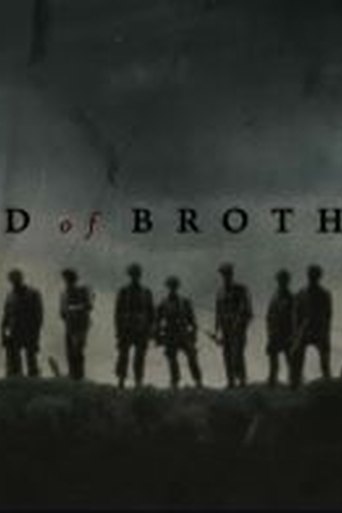
Band of Brothers · Season 1 · Episode 7 · 14 October 2001
S1E7 The Breaking Point
A punishing Foy hour where Lipton's clarity cuts through shellfire, while Dike's confusion makes command itself the wound.
The episode opens with a mood shift that feels like a command voice turning into a confession. Easy Company is deep in the machine now, where “what happened” stops being enough and “why it happened” becomes the only thing that keeps men moving. The hour leans into the blunt arith
Full episode analysis below. Spoiler-light verdict above.
Updated
The narrator frames the hour before the fighting swallows it: those events would come back, and you never forget them. Then the episode proves the line without decoration. A report comes in that nobody is out there, and the scene becomes the discovery that Hoobler has shot himself. His death is quick and horrifying. No grand speech. No battlefield glory. A bullet cuts the main artery in his leg, and he is gone.
Episode 7 is about the moment discipline stops being a military virtue and becomes survival gear. When command shakes, the men who hold the line are the ones who can still think.
A Death Before the Battle
The Hoobler incident is the hour's bluntest warning: danger is no longer waiting across the field. It is inside the company, inside the quiet moments, inside a weapon handled badly after nerves and exhaustion have done their work. The early report that there is "Nobody out there," credited to an unknown soldier, lands like a cruel setup. The enemy is absent. Death is present anyway.
That matters because Episode 7 is built around pressure before it is built around German fire. The narrator's memory line gives the hour its spine, then Hoobler's death supplies the first proof. These men are carrying too much for too long, and the episode refuses to make trauma look poetic. It makes it procedural. A wound. A main artery. A dead soldier.
That plainness is the craft. The episode does not need a slow-motion lament when the mechanics of the death already say enough. Hoobler is killed by accident, but the accident does not feel random in the dramatic sense. It feels like one more consequence of a unit living with violence as routine. The hour understands that combat drama grows sharper when it shows the damage before the famous assault begins. Foy is coming, but the breaking point has already arrived.
Lipton Becomes the Shape of Order
If the hour has a moral centre, it is Lipton trying to turn panic into sequence. He keeps things organized during shelling and assaults, calling for cover and coordinating response when men go down. That is not flashy heroism. It is the work that keeps a collapsing scene readable.
The dialogue tightens around sudden combat cues, especially the repeated calls to take cover and find cover. Men are not speaking to explain themselves. They are speaking to survive the next ten seconds. Lipton's function in that noise is structural. He gives the hour a rhythm of response: barrage, injury, call, movement. Then the next barrage comes.
That is why the moment after Guarnere is hit carries force. Lipton tells someone, "We got you, soldier." It is a simple line, and the episode earns it by placing it inside chaos rather than after it. Comfort here is triage with a human voice.
The strength of Episode 7 is that it lets Lipton's competence contrast with the larger failure of command without turning him into a superhero. He is scared enough to understand the danger and steady enough to act anyway. The hour keeps returning to that difference. In this episode, leadership means clarity under fire.
The Joke Dies in the Second Barrage
The tonal turn around the shelling is one of the episode's cleanest moves. The men begin with enough air in the scene for joking, then the second barrage removes it. The remembered line says the shift plainly: during the second barrage, the laughter stops. War allows a joke until the math gets too accurate.
The targeted shelling is marked by the alarm that they have been zeroed. From there, the episode compresses everything. Dialogue spikes. Urgency replaces banter. Calls for help turn the forest into a map of injuries. Guarnere senses the doom before it lands near Foy, saying that someone is going to die. The line is crude, direct, and right. Its power comes from the fact that the episode treats it as field knowledge rather than prophecy. He knows the pattern. He can feel the cost coming.
Buck Compton gives that cost a different face. He wants to push forward and rejoin the fighting, but after seeing friends broken by the barrage, especially Guarnere and Joe Toye, he can no longer continue. That break is brutal because it denies him the soldier's preferred answer to grief: get back in. His body remains present for a moment, but his mind has been forced past its limit.
Here the episode is at its best. It makes collapse physical. A man goes down. Another cannot go on. Another keeps calling for cover. No speech can organize that pain cleanly, so the episode does not force one.
Dike Turns Uncertainty Into a Casualty
The central contradiction belongs to Dike. He holds the command, but the fight exposes a command flow without clarity. The key line at the breaking point is "I don't know, I don't know!" That uncertainty is not background noise. It is the conflict.
The episode's treatment of Dike is sharp because he is not simply absent from the idea of leadership. He remains attached to the assault plan and physically present during the Foy attack. The problem is worse than disappearance. He is there, but the plan around him does not become clearer. In combat terms, that is poison. Men can endure fear when orders cut through it. They cannot build momentum out of hesitation.
The episode also leaves some accountability slightly blurred around Dike's earlier absences and the company's inability to rely on him. That blur fits the experience of men inside the fight, where information arrives broken and late. As drama, though, it softens the full force of the failure. The episode knows Dike is ineffective. It could press harder on the exact shape of that ineffectiveness.
Even with that reservation, the Foy assault works because confusion has been planted before the bullets start deciding things. By the time Speirs is sent in and the company regains forward motion, the action has become a test of whether anyone can restore purpose fast enough to keep men alive. The answer is strained and costly. That honesty keeps the episode from easy triumph.
Foy Is Won One Threat at a Time
The late movement through Foy avoids the clean victory pose. After taking many German prisoners, the men continue moving and clearing as they go. The command is practical: move it. The episode stays on task because the danger has not politely ended. A weaker hour would make the taking of prisoners feel like closure. Episode 7 treats it as another phase of exposure.
Lipton identifying the sniper on the second floor, building on the right, is a perfect late beat for the hour's argument. After the collapse, shelling, uncertainty, and command failure, survival still comes down to someone seeing clearly and saying the useful thing in time. That is the episode's earned definition of control. Identification before another body falls.
The unresolved sniper threat also keeps the ending from becoming too tidy. Multiple men have been killed or wounded, and the unit is still processing danger in fragments. The hour's final shape is less about victory than function. Can Easy Company still operate? Can it keep moving? Can it recognize the next threat before that threat takes another man?
Episode 7 answers yes, with a visible limp. That is why the hour carries weight. It does not confuse endurance with healing. The narrator's opening warning remains active at the end. These events do not pass through the men. They lodge.
The Verdict
Episode 7 is a severe, disciplined hour about command under pressure, and its best decision is to make leadership visible through action rather than speeches. Hoobler's death establishes the fragility, the barrages strip away bravado, Lipton supplies order, and Dike's uncertainty turns the Foy assault into a tactical stress test. The episode's one weakness is the slight haze around Dike's missing stretch, which serves the chaos but limits the precision of the indictment. Still, the craft is formidable. The hour understands that a battle is won by more than taking ground. It is won by the men who can still call cover, locate the sniper, and keep the line moving while memory is already turning into damage. In the season arc, this is where leadership becomes the difference between motion and ruin.