One Piece (Live-Action) · Season 1 · Episode 1 · 31 August 2023
S1E1 Romance Dawn
“Romance Dawn” makes Luffy’s comedy function as philosophy, turning authority into a punchline with real consequences.
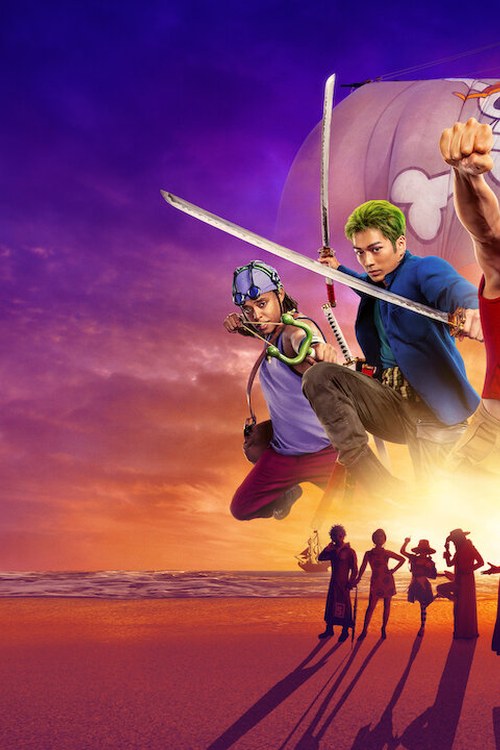
THE MOMENT Zoro's three-sword oath at Shells Town - the character's defining moment from the manga translated to live-action with full commitment and no embarrassment.
A pirate ship hits shore like it’s late for a date, cannon smoke mixing with laughter. **Monkey D. Luffy** runs straight into authority, not to win permission but to test the world’s limits with his body, his grin, and his stubborn belief that “mine” is a temporary label. Then th
Full episode analysis below. Spoiler-light verdict above.
Updated
COLD OPEN
A pirate ship hits shore like it’s late for a date, cannon smoke mixing with laughter. Monkey D. Luffy runs straight into authority, not to win permission but to test the world’s limits with his body, his grin, and his stubborn belief that “mine” is a temporary label. Then the hour pivots: it stops treating Luffy like a novelty and starts treating him like a problem that multiplies. By the time the smoke clears, the question is simple. Can a man with no fear and no plan survive a world built on rules?
spoiler_free
The episode opens with Monkey D. Luffy doing what he always does, grabbing danger by the collar and running at it like it’s a joke told too early. “Romance Dawn” builds Luffy’s moral engine through action, then anchors the story by introducing Captain Kuro, Captain Morgan, and the island power web that will try to crush him. BollyAI’s read: the hour’s best trick is refusing to let “origin story” become “origin apology.” It earns its comedy, then turns it into leverage. Where it stumbles, the plot leans on familiarity rather than discovery, but the character chemistry makes that trade feel intentional.
THESIS: This hour sells Luffy by making action feel like character, not plot.
“Romance Dawn” is a pilot that understands a single job: don’t translate an anime into live-action. Instead, translate the source’s rhythm into something the camera can trust. BollyAI’s read is that the episode achieves that by treating Luffy’s chaos as a consistent philosophy. His choices are loud, but they are not random. Even when the hour borrows set pieces you recognize, the writing frames them as tests of will. The comedy is not decoration. It’s the delivery system for stubborn ideals.
## A Boy Who Keeps Touching Fire
The episode’s first and biggest character statement is Monkey D. Luffy refusing the normal relationship between fear and survival. He isn’t reckless because the show wants him to be reckless. He is reckless because, to him, rules are just suggestions the world makes before it gets embarrassed. The live-action staging matters here. The physical comedy is built from clear, readable action beats, not vague manga energy, and that readability keeps the gags from collapsing into chaos. Luffy’s grin works because the hour consistently puts him in situations where smiling is a choice, not a mood.
BollyAI’s read: the pilot’s confidence shows in how it shoots Luffy’s confidence. When danger arrives, the camera treats it like weather, something that happens around him. When Luffy moves, it treats movement like language. That is why the introduction lands as more than “cute protagonist.” It lands as a worldview.
The hour also plants a useful tension. Luffy is a contradiction machine. He can be warm, impulsive, and brave in the same minute, but the same quality that makes him lovable also makes him predictable to people who want to control him. The story’s early villains do not fear him the way stronger pirates would fear a threat. They fear him the way a system fears a glitch. That framing is craft. It turns “power fantasy” into “conflict engine.”
## A Town That Thinks It Can Own Weather
The next gear shift comes from Captain Morgan and the island’s authority structure. The episode uses authority not as a generic obstacle but as a performance. Morgan’s role reads like a ruler who believes legitimacy is branding, and the hour lets that arrogance show in how rules get enforced, selectively, theatrically. That matters because Luffy’s comedy needs something to bounce off. If everyone around him was equally competent and equally fearful, the joke would flatten into noise.
BollyAI’s read: this is where “Romance Dawn” manages something many adaptation pilots forget. It gives the environment a mood. The town is not a neutral container for Luffy’s antics. It has incentives. It has reputations. It has people who will help, not because they’re kind, but because they’re attached to the idea of order.
Even when the episode hits familiar narrative stops, it makes a point to show consequences in human scale. The show’s best scenes do not just tell you the system is corrupt. They show you who pays for that corruption when Luffy’s arrival forces the system to react. That is the difference between action as spectacle and action as social pressure.
## The Enemy As Comedy, Not Monster Work
The pilot also keeps its antagonism from becoming “villain of the week” energy by balancing threat with comic rhythm. Captain Kuro and the pirate politics around him are staged like a contest in confidence. They talk big. They posture. They perform menace. But the episode’s camera language keeps asking: is that real power, or just a costume?
BollyAI’s read: the show’s adaptation choice is smart here. Live-action can over-weight stakes with grim lighting and melodramatic violence too quickly. This episode instead uses timing. The comedic beats are not forgiving, but they are precise, and that precision gives the threat a sharper outline. When the hour lets a character’s cruelty show, it has earned the right to feel ugly rather than merely loud.
This is one of the pilot’s clearest arguments. Luffy is not just “the hero.” He is also the audience’s moral accelerant. The episode uses him to reveal what people choose when they can. Some choose kindness. Some choose control. Some choose profit. That variety keeps the hour from turning into a simple “good pirate vs bad pirates” grind.
## The Pilot’s Real Magic: It Treats Rules Like Punchlines
“Romance Dawn” understands that adaptation success is timing discipline. The hour repeatedly turns rule enforcement into a punchline, then turns the punchline back into a consequence. That sounds like a contradiction, but it is actually the show’s consistent writing approach.
BollyAI’s read: the strongest craft move is how the episode structures escalation. It doesn’t just increase danger. It increases clarity. Each major interaction teaches you what Luffy believes, what he refuses, and how other people interpret him. Authority tries to translate him into a category, “threat,” “nuisance,” “criminal.” Luffy refuses the category. He keeps acting like the world is a negotiation he never agreed to but will still win by being himself.
That negotiation style also builds the ensemble promise without sprinting into it. By the end, the episode feels like the beginning of a crew story even though the crew is still a concept in motion. The pilot uses movement through the town, through conflict, through embarrassment, as a way to foreshadow how a group might form. Not through speeches, but through repeated tests.
## A Few Familiar Tracks, But the Engine Is New
If there is a weakness, BollyAI’s read is that the hour occasionally leans on recognizability instead of discovery. Certain beats land because viewers expect them, and the script sometimes treats that expectation like a shortcut rather than a challenge. That can slightly reduce suspense in moments that should have felt like new information.
However, the acting and staging keep covering for that thin edge. Monkey D. Luffy plays as if he’s always mid-decision, always converting instinct into action. Captain Morgan plays as if he’s always monitoring how others are perceiving him. Captain Kuro is less about depth and more about cadence, a character whose menace depends on control of the room. The chemistry between these performances helps the plot feel like it’s moving even when it is temporarily mapping well-known terrain.
Most importantly, the episode’s ending position feels purposeful rather than ornamental. It gives you reasons to care about the next part of the voyage, and it sets the tone that the show will keep using humor as a weapon, not a shield. That is the signature promise of this series, and the pilot keeps it.
The Verdict
“Romance Dawn” earns its pilot slot by treating Luffy’s chaos as a moral engine and letting comedy do structural work. The episode sets up authority as performance, stages threat with timing instead of melodrama, and shoots action so it reads as character, not mere spectacle. Where the hour can feel slightly familiar, the performances and rhythm cover the gap. BollyAI’s read is that this is not just an opening. It’s an adaptation thesis, a statement that the source’s energy can survive translation if the camera respects how characters decide, not just what they do.
Season-arc sentence: by planting Luffy as a walking contradiction and shaping the world around him as a system that can be embarrassed, the show sets up the season to become a crew-building argument against control itself.