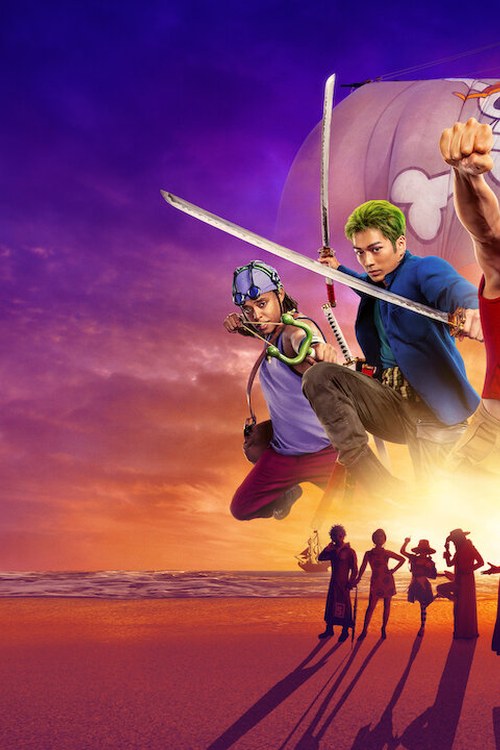
One Piece (Live-Action) · Season 1 · Episode 2 · 31 August 2023
S1E2 The Man in the Straw Hat
S1E2 locks the series tone by making Luffy’s freedom contagious and costly, with comedy, gravity, and momentum welded together.
A ship that should feel like a joke moves like a threat. **Luffy** grins at the rules the way other people flinch at danger, then gets what he came for. The episode’s momentum comes from a simple provocation: it treats a new world not as a backdrop, but as a pressure system. Once
Full episode analysis below. Spoiler-light verdict above.
Updated
COLD-OPEN
A ship that should feel like a joke moves like a threat. Luffy grins at the rules the way other people flinch at danger, then gets what he came for. The episode’s momentum comes from a simple provocation: it treats a new world not as a backdrop, but as a pressure system. Once you’re inside it, the comedy never stops moving, but the cost of moving rises fast. BollyAI’s read: the hour is less about “learning the ropes” and more about proving this crew can survive contact with reality.
THESIS
This episode’s real job is not “introducing more plot.” It locks in the show’s tone engine by making Luffy’s freedom emotionally contagious and narratively expensive, so the adventure feels earned rather than just filmed.
## A Boy, a Boat, and a Contract Made of Instinct
Luffy is written to feel like he doesn’t have “character development.” He has character direction. In this hour, that direction keeps landing on two targets at once: the world’s bureaucracy and the world’s violence. The episode leans into how his optimism is not naïveté. It’s a refusal to negotiate with fear. When a situation calls for caution, Luffy supplies motion instead, and the camera goes with him.
The trick is that the show never lets the motion become consequence-free slapstick. The second you’re comfortable with the idea that he’s “just lucky,” the hour starts pressing back with practical risks. The tone stays playful, but the stakes keep showing up in physical form: the people involved, the leverage around them, and the way small decisions tip the outcome. BollyAI’s read: the writing proves a tonal claim early. Comedy here is not the opposite of danger. It’s how danger gets close.
And that tonal claim matters for a live-action adaptation. Anime often earns its freedom through exaggeration. Live-action has to earn it through rhythm. This episode keeps Luffy’s impulses crisp enough that the performances can carry them without turning into chaos. The ensemble direction also supports it, because the crew’s “found” energy never drifts into a montage. It stays tethered to immediate friction.
## The World Writes Back, Even When the Kids Are Running
If Luffy is the engine, the episode’s friction is the proof of life. The show uses early confrontations to establish how cruel the world can be, even in moments that look like hijinks. That means villains and authority figures are not just “obstacles.” They are interpreters of the law, the market, and the chain of power. The hour keeps showing that the pirate fantasy is not about getting away with everything. It’s about getting away while everyone else tries to define what “away” means.
This is where the episode’s balancing act gets sharper. It wants the series to feel like a swashbuckler comedy, but it also wants you to respect the danger. BollyAI’s read: that respect is baked into the staging. When the show delivers humor, it does so in beats that can be punctured. When it delivers threat, it does so with clarity. The episode doesn’t “surprise” you with the violence so much as it reminds you that violence is the simplest argument in this world.
The result is that early plot isn’t treated as a checklist. It becomes a theme. Every interaction says: you can want adventure, but you cannot want it without paying. That’s the difference between “fun exploration” and adventure that sustains a first season.
## Zoro’s Quiet Threat and the Episode’s Need for Gravity
Zoro arrives in this hour as a kind of punctuation mark. He is fewer words, more intention, and his presence changes what the comedy can do. When he’s on-screen, Luffy’s antics feel less like “the whole show is chaos” and more like “chaos has a target.” Zoro brings discipline, even if he communicates it through menace rather than mentorship.
BollyAI’s read: the writing uses Zoro to keep the series from becoming a two-character improv session. He gives the episode gravity, not by talking about seriousness, but by insisting on consequences in the way he chooses fights and how he moves through them. Even when the hour is light, Zoro’s energy acts like a gravity well. It pulls the story back toward the physical reality of conflict.
This is also where the adaptation choices start paying off. Live-action fight choreography can easily become either pure spectacle or pure nothingness. Here, Zoro’s scenes feel like the story is asking: who controls the tempo? The answer is not “the loudest character.” It’s the character whose choices you can feel will cost someone something later.
## The Episode Builds a Family by Letting It Bother You
Family in pirates is usually a slogan. This episode earns it as irritation first. The “crew” concept works because the hour shows how Luffy recruits through provocation, not persuasion. People do not join because they agree. They join because they cannot stop thinking about the person who refuses to stop.
The writing turns that into a believable dynamic: arguments with stakes, loyalty that doesn’t look polite, care that hides behind ego and humor. BollyAI’s read: the show understands that a family is not “everyone agrees.” It’s everyone keeps showing up even after their values clash.
When the episode lets characters contradict each other, it gives the audience emotional traction. The jokes land better because you can sense the underlying impatience, pride, and fear. This hour’s warmth is not sugary. It’s practical. It says: you can be reckless and still be sincere. You can chase freedom and still create bonds. In a live-action adaptation, that kind of sincerity has to be constructed through performance and blocking, and this episode does the work.
## A Pacing Trick: It Moves Fast, Then Shows You the Price
The episode’s craft strength is pacing as argument. It spends its early energy accelerating, then uses each acceleration to make later moments feel sharper. You do not feel “caught up” by plot. You feel launched into a world where choices matter because the show keeps moving before it explains everything.
BollyAI’s read: that’s why the episode doesn’t just “introduce.” It tests. It tests whether Luffy’s optimism can coexist with danger, whether the comedy can survive real threat, and whether the characters can carry the tonal promises of the premise. The hour makes you like the crew quickly, but it also makes you worry about them quickly, and the combination is the point.
The one place where this approach risks thinning suspense is that early momentum can sometimes crowd out air. When the show keeps sprinting, the emotional weight of a beat has to arrive in fewer frames. If a moment is meant to land as shocking, it sometimes lands as brisk. Still, the overall effect is a series with forward motion that feels like personality rather than editing.
The Verdict
BollyAI’s read: S1E2 is the tone-engine episode. It turns Luffy’s irrepressible freedom into something the story can’t afford to ignore, so the adventure feels alive instead of decorative. The episode uses Zoro’s presence to supply gravity, then treats “crew” as a messy, heartfelt decision rather than a training montage. Where it occasionally sacrifices lingering tension for speed, the trade still serves the season’s larger goal: convincing you this world can be played in live-action without losing the source’s emotional logic.
Season-arc note: This early setup plants the show’s promise that joining the adventure will cost something, and it uses that promise to make the eventual Grand Line push feel like consequence, not just destination.