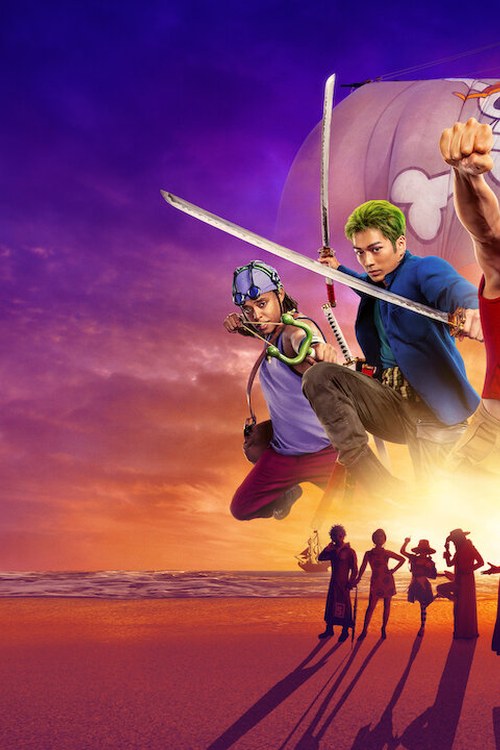
One Piece (Live-Action) · Season 1 · Episode 3 · 31 August 2023
S1E3 Tell No Tales
S01E3 turns Luffy’s swagger into a functional plan, building crew trust through pressure rather than destiny.
A fight breaks out in a way that feels less like a test and more like a dare. A shipboard rule gets bent, then snapped, and the people who should know better start bargaining with danger. Luffy treats the chaos like an opening, not a threat, pushing forward when everyone else rea
Full episode analysis below. Spoiler-light verdict above.
Updated
One Piece (Live-Action) S1E3: S01E03 Review
Spoiler-light verdict above. Full episode analysis below.
### COLD-OPEN A fight breaks out in a way that feels less like a test and more like a dare. A shipboard rule gets bent, then snapped, and the people who should know better start bargaining with danger. Luffy treats the chaos like an opening, not a threat, pushing forward when everyone else reaches for permission. The camera watches him ignore the obvious “don’t” and immediately turns that defiance into a plan. BollyAI’s read: this hour is where the show stops pretending it’s just adapting and starts proving it understands pirate logic.
The Betrayal of Expectations That’s Actually a Choice
In the first two episodes, Monkey D. Luffy has mostly been motion with a smile, a kid with a mission statement written in rubber bands. Captain Buggy (and the surrounding criminal ecosystem) exist as the “oh right, the world can be cruel” part of the lesson. By S01E3, the adaptation has to do something harder than stage action. It has to make the crew’s formation feel like consequence, not coincidence.
BollyAI’s read is that S01E3’s core craft move is how it handles expectation. Pirate stories love the fantasy of destiny. This hour keeps pulling you toward it, then refuses the easy version. Luffy does not “become” a leader through a grand speech. He becomes one through decisions that cost him something small, then compounding something bigger. The show keeps asking, “Is this reckless?” and then answers, “Yes, and that’s why it works.”
That is the hour’s thesis energy. It treats choice as the engine of character. When people around Luffy pivot, it is not because plot decrees it. It is because his insistence forces real reactions. The episode’s comedy lands because the premise stays consistent: Luffy is not clever in the academic way. He is clever in the survival way. He makes other people’s fear do the steering for him, and then he drives.
A Crew Built on Momentum, Not Agreement
The biggest adaptation problem with a series like One Piece is that the source material runs on personality density. In animation, the exaggeration can be frictionless. In live-action, if personality does not move with discipline, it becomes noise. S01E3 is where the pacing discipline shows.
Roronoa Zoro is still the anchor of “cool under pressure,” but the hour uses him less as an action icon and more as a boundary. He is the line the story uses to measure whether Luffy’s chaos is just chaos. When Zoro reacts, the episode quietly communicates what the show wants from their dynamic: not “teamwork as harmony,” but teamwork as negotiated stability. The writing gives Zoro moments that read like a professional’s annoyance at amateur hours, which makes the eventual cooperation feel earned rather than assigned.
Meanwhile Nami (still functioning as the survival-brain of the group) matters because she represents the episode’s refusal to romanticize. She has reasons. She has a plan. And the show uses those traits to show why pirate comedy works: it is the clash between somebody who wants order and somebody who refuses to admit order exists.
BollyAI’s criticism, honest and specific: S01E3 can feel like it’s briefly auditioning multiple tones at once. The hour wants to be funny, fast, and mythic, and sometimes the transitions land a beat later than the action wants. That slight tonal delay risks flattening one character beat into “another problem to solve.” The upside is that the episode corrects course by the end and ties the laughs back into the crew’s momentum, instead of letting the comedy float free.
Pacing as a Weapon Against the “Live-Action Betrayal” Fear
One reason S1 of this show was worth rooting for is that it knew where previous anime-to-live-action efforts often stumbled: too much explanation, too much gravity, not enough propulsion. S01E3 continues the corrective.
BollyAI’s read is that this episode uses pacing like a director. It starts charged. It keeps the scene pressure high. It avoids dwelling on the “why” until the “what happens next” has already pulled you forward. Even when the hour needs setup, it packages setup as confrontation: a question is asked, a misread happens, then Luffy’s attitude turns the misread into movement.
That matters because pirate adventure is not supposed to feel like a lecture with costumes. It is supposed to feel like a machine you are allowed to ride. The show’s craft here is that it makes the ride believable by keeping cause and effect legible. People do not teleport from beat to beat. They decide, then they pay, then they decide again.
If the series has a promise, it is that the “source audience” logic is respected. S01E3 earns that by keeping the comedy in-service of plot pressure, not plot padding. The episode understands that a laugh is a release valve, and release valves are only satisfying when the fire underneath remains hot.
The Show’s Real Magic Trick: Making Confidence Look Like Work
Live-action adaptations often fail by treating confidence as charisma and leaving the labor off-screen. Monkey D. Luffy cannot simply be a vibe. He has to look like he is earning outcomes through choices. S01E3 leans into that.
BollyAI’s read: the episode’s most persuasive scenes are those where Luffy’s confidence bumps into reality and then adapts, fast. His optimism is not passive. It is tactical. Even the comedic beats have a function, because they keep Luffy from becoming a hero who only wins through luck.
The hour also clarifies what “family” means in this world. It is not blood. It is not destiny. It is the willingness to keep choosing each other after the first failure. When the episode reframes risk as something that can be shared, the relationships stop feeling like recruitment and start feeling like belonging-in-progress.
If there is a weakness, it is that the episode sometimes needs one more breath to fully register certain emotional turns. When you compress too many character dynamics into a short runtime, you can end up with strong performances that are not quite allowed to echo. The writing tries to outpace that by leaning on action clarity, and it mostly succeeds. The cost is that a couple of quiet beats feel slightly underlit compared to the louder set-ups.
The Verdict
S01E3 is a momentum-builder that treats crew chemistry as a product of pressure, not an outcome of paperwork. BollyAI’s score would track confidence in the show’s craft: it keeps pirate logic legible, uses pacing to prevent explanation bloat, and makes Luffy’s optimism look like decision-making under fire. The tonal transitions occasionally feel like they arrive a half-step late, but the episode corrects by tying comedy back to forward motion.
Across Season 1, this hour matters because it keeps converting charisma into structure. It plants the idea that the crew is not a collection of types. It is a machine assembled through choices that cost something, then keep going anyway.